
Virtual Greyhounds vs Virtual Horse Racing Payouts
 Available in US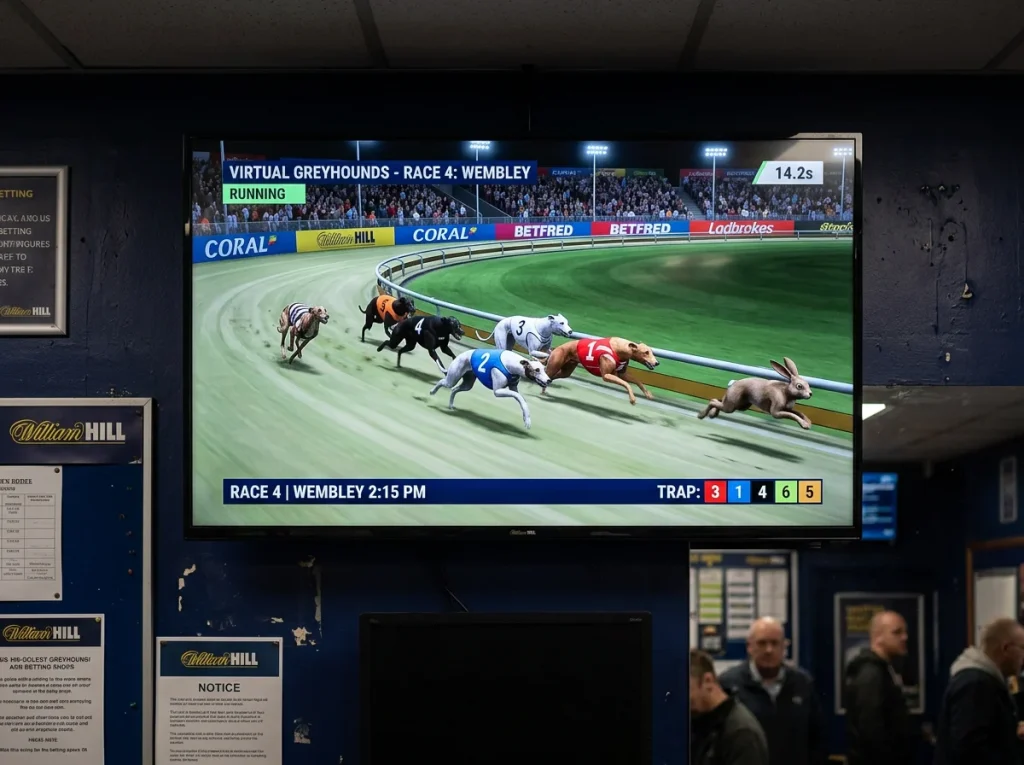
Contrasting Cycle Lengths Between Virtual Dogs and Horses
The first time someone asked me whether virtual greyhound racing was a fundamentally different product from virtual horse racing or simply the same thing wearing fur, I had to think about it for a moment. The honest answer is that the two are closer than the visual presentation suggests. At the technical layer — the RNG, the probability model, the certified band of expected return — they are often the same engine running with different parameters. The animal on screen changes. The mathematics underneath frequently does not.
This matters because UK customers who treat virtual greyhound racing as a separate category, with separate strategies and separate expectations, are often making assumptions that the underlying product does not support. The supplier behind a major operator’s virtual horse racing offer is, more often than not, also the supplier behind its virtual greyhound offer. Inspired Entertainment’s product launch into the Turkish market in February 2026 through the Gametech MediaHub deal explicitly bundled Virtual Horse Racing and Virtual Greyhound Racing as a single content package. That bundling reflects how these products are sold and integrated at the operator level — as variants within one supplier portfolio rather than as fundamentally different products.
The cycle rhythms cited across the suppliers — William Hill’s five-minute cycle, Mohio’s three-minute on six-runner cards and four-minute on eight-runner cards, Inspired’s two to three-minute cycle, Paddy Power’s two-minute cycle — apply across both virtual horse racing and virtual greyhound racing where the operator runs both. The choice of which animal occupies screen time at any given moment is an operator scheduling decision rather than a technical one.
What follows is a working comparison of the two products, where they share architecture and where they genuinely diverge, written for a UK customer who wants to understand whether the differences matter.
The Shared Engine: One Provider, Two Skins
Take any of the major UK virtual sports suppliers and look at the engineering documentation behind their product portfolio, and the structural pattern is consistent. The core RNG is a single certified component that generates random sequences to feed into the supplier’s broader probability model. The probability model is configured per product — horse racing parameters for the racing product, greyhound parameters for the dogs product — but the RNG itself is the same audited component across both.
The probability model is where the products diverge in their input parameters but not in their algorithmic structure. For horse racing, the model generates probabilities across six to eight virtual runners based on the supplier’s calibrated probability distribution for that product. For greyhound racing, the model generates probabilities across six virtual dogs — six is the standard field size for greyhound racing both real and virtual, derived from the six-trap layout of physical greyhound tracks. The number of runners changes. The fundamental mechanism does not.
The RTP band is configured per product within the supplier’s certified range. Where Inspired publishes an RTP band of 80% to 92.1% across virtual horse racing bet types, the equivalent band for the supplier’s virtual greyhound product sits within a similar range, with bet-type-specific calibration applied. The operator running both products typically configures them to comparable RTP positions to maintain commercial consistency across the portfolio. A customer betting on virtual horse racing and virtual greyhound racing at the same operator is, in long-run expected return terms, facing very similar mathematical conditions.
The visual presentation is where the products diverge most visibly. The horse animations involve longer-bodied animals with riders, set against turf or all-weather track imagery. The greyhound animations involve leaner profiles, no riders, and the characteristic six-trap start sequence. The audio cues differ. The commentary patterns differ. The race takes a different amount of screen time even at comparable cycle lengths. But underneath the audio-visual layer, the supplier is running variations of the same engine.
Different Markets: Forecast, Tricast, Reversi
The bet menus on virtual horse racing and virtual greyhound racing share substantial overlap but with several meaningful differences worth noting.
Win and Place bets exist on both products. The Win bet is the simplest market in either case — pick the winning runner. The Place bet is configured per product based on field size: on six-runner virtual dogs, Place typically means a top-two finish, while on eight-runner virtual horses Place is more commonly a top-three finish. These thresholds are aligned to the supplier’s probability distribution and the operator’s overround calibration.
Forecast and Tricast — the UK-named exotics — appear on both products. Straight Forecast asks for the first two finishers in exact order. Reverse Forecast covers both possible orderings. Tricast asks for the first three in exact order. These markets work the same way mathematically across horses and dogs, with the same synthetic-dividend calculation methodology.
Where the products diverge is on Each-Way. Virtual horse racing typically offers Each-Way as a default bet on the menu, with place fractions configured per field size — usually one-fifth of the win odds on a three-place card. Virtual greyhound racing more often omits Each-Way from the standard menu, partly because the six-runner field is too small for a generous each-way structure and partly because greyhound racing convention historically uses Place rather than Each-Way as the main protective market. Customers who expect Each-Way on virtual dogs and find it absent are running into this convention.
Reversi — the bet that covers a Forecast either way at a single stake-per-combination rate — appears on virtual greyhound racing more commonly than on virtual horse racing in some operator menus. The bet is functionally similar to a Reverse Forecast but with a different stake-handling convention. Whether an operator offers Reversi as a distinct menu item or only under the Reverse Forecast label is a presentational choice.
The US-named exotics — Exacta, Quinella, Trifecta — appear on both products at operators that offer the dual UK and US notation. The settlement on virtual greyhound markets uses the same synthetic dividend methodology as virtual horse racing, with mathematically equivalent payouts for equivalent outcomes.
Cycle and Pace: Where They Diverge
The cycle lengths for virtual greyhound racing tend to be shorter than for virtual horse racing across the same supplier, and the difference is design rather than coincidence.
A virtual greyhound race is a shorter event than a virtual horse race. A real greyhound race over a typical UK distance takes about thirty seconds. A real horse race over a typical UK distance takes between one and four minutes depending on the trip. The virtual products reflect these timings — virtual greyhound races complete their on-screen action in well under a minute, while virtual horse races run for a minute or more. The cycle between races — the build-up, the betting window, and the result settlement — fits the race length and the operator’s commercial preference for cycle pacing.
This is why a single operator may run virtual greyhounds on a two-minute cycle and virtual horses on a three-minute cycle from the same supplier. The dogs product packages more rounds into the same time window. For a customer this means the engagement loop on virtual greyhound racing is faster and tighter than on virtual horse racing. Sessions accumulate cycles more quickly. The compressed decision-making window for the customer applies more sharply.
The shorter cycle also has implications for the retail channel. Where virtual horse racing fits into a betting shop’s between-races filler programming, virtual greyhound racing can squeeze into smaller gaps in the real-race schedule. A shop running both products through the day can configure greyhounds to fill the very short windows between real races and horses to fill the larger ones. The retail rhythm benefits from having both formats available rather than running one or the other exclusively.
From a responsible-play perspective, the faster cycle of virtual greyhound racing amplifies the same risk dynamic that applies to virtual horse racing — short feedback loops, compressed decision-making, accumulated drift over a session. The UK responsible-play tools — deposit limits, reality checks, GamStop, time-outs — apply identically to both products because they are both regulated UKGC virtual sports under the same licensing framework.
What This Means for a UK Punter
For a UK customer choosing between virtual horse racing and virtual greyhound racing, the practical takeaway is that the choice is more about preference for animation style, cycle pace and bet-menu structure than about any fundamental difference in expected return or mathematical fairness. The supplier’s engine treats both products with the same RNG certification, the same probability-model architecture, and broadly equivalent RTP calibration.
The differences worth weighing are: field size (six dogs versus six to eight horses), cycle speed (greyhounds typically faster), Each-Way availability (more reliably present on horses), and the visual experience (different enough that personal preference matters). None of these differences shift the underlying economics in a meaningful way.
What this also means is that the strategic depth a customer can apply to virtual greyhound racing is no greater than what they can apply to virtual horse racing. There is no form to study. There is no draw bias to weight. There is no trainer or trap-history signal to read. Both products are mathematically pre-stamped books with operator-calibrated overround. The decision the customer is making is which animation and which cycle rhythm they prefer to consume.
For a customer specifically focused on the Inspired Racing product, the broader context of Inspired’s content and its UK retail distribution is something I cover in more detail in my piece on the Inspired virtual horse racing product guide.
Frequently Asked Questions
Is the RNG behind virtual greyhounds the same as behind virtual horses?
At the major UK suppliers — Inspired, Playtech, Mohio — yes, the core RNG is a single certified component used across the supplier"s virtual sports portfolio. The probability models that translate RNG outputs into race outcomes are configured separately per product, but the underlying random source is shared. The labs — eCOGRA, GLI Europe BV — certify the RNG once for the supplier rather than per product.
Do virtual greyhound markets pay each-way?
Less commonly than virtual horse racing markets. Greyhound racing convention historically uses Place rather than Each-Way as the main protective market, and the six-runner virtual field is too small for a generous each-way structure. Where Each-Way does appear on virtual dogs, place terms are typically tighter than on horses — often one-fifth on two places rather than three.
Why are virtual greyhound cycles often shorter than virtual horse cycles?
A real greyhound race takes about thirty seconds to run, against one to four minutes for a real horse race. The virtual products mirror these timings, so the on-screen race itself is shorter for greyhounds. The cycle length between races — including build-up and settlement — fits the race length. The result is that virtual greyhound racing packages more rounds into the same time window than virtual horse racing.
Articles
Created by the "Horse Racing Bet Game" editorial team.
