
Reading a Virtual Horse Racing Card
 Available in US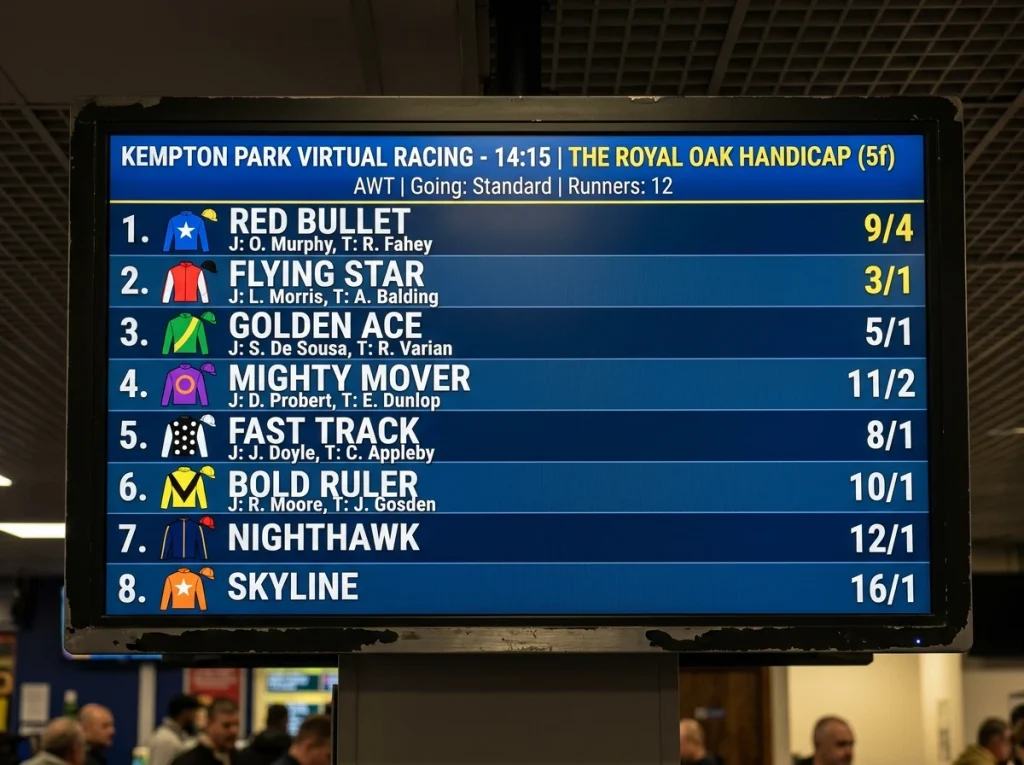
A Virtual Card Is Smaller — and Lies About Form
I once watched a customer in a betting shop spend three minutes studying a virtual horse racing card with the intensity he would normally apply to a real Lingfield handicap. He was looking for form. He was looking for trainer notes. He was looking for some indication of which of the eight cartoon horses in front of him had genuine credentials over the trip. There were none of those things to find. The card he was reading was, by design, a card without that information — and the customer was working hard at extracting signal from a presentation that had no signal embedded in it.
This is the trap that virtual horse racing cards set for customers who carry real-race habits across to the virtual product. The card looks like a real-race card. The runners have names. The odds are displayed in familiar fractional or decimal format. The silks have distinct colours. The visual presentation reads like the form pages of a racing paper. But underneath the presentation, the only meaningful information on a virtual card is the displayed odds, because everything else is decoration. The horse names are placeholder strings drawn from a name pool. The silks are randomly assigned from a colour palette. The trainer and jockey, where listed at all, are synthetic identities with no continuity across races.
What is left, once you strip away the misleading visual furniture, is the odds. The Inspired Racing RTP band of 80% to 92.1% across bet types and the Coral Playtech engine’s 90% RTP are both delivered through the displayed odds. The probability model lives in those numbers and nowhere else. Reading a virtual card honestly means reading the odds and treating the rest as art direction.
This article walks through what is actually on the card, what is missing compared to a real card, how to use the odds without self-deceiving, and how to keep the RTP context in mind when you make your selection.
What Is Actually on the Card
A typical UK virtual horse racing card displays five or six elements per runner, and each is worth knowing for what it tells you and for what it does not.
The runner number is a sequential identifier — typically 1 through 8 on an eight-runner card — corresponding to the position the horse will start from. On a real card this number carries some weight because of draw bias, particularly on flat racing over short distances where the starting position can affect winning chances. On a virtual card the number carries no equivalent weight. The supplier’s probability model does not penalise or favour any particular runner number, because the virtual track has no physical bias to encode. The number is purely a label.
The horse name appears on the card in the position where a real card would print the name. The names are drawn from a pool maintained by the supplier — Inspired’s pool, Playtech’s pool, Mohio’s pool — and the same names recur across multiple races as the supplier rotates through the pool. A customer who plays virtual racing regularly will recognise names appearing repeatedly, which sometimes prompts the mistaken assumption that the name carries a track record. It does not. The name on one race has no continuity with the same name on a previous race. Each appearance is a fresh runner with fresh randomly generated probabilities.
The silks — the colour and pattern of the riding jersey — are assigned per runner per race from the supplier’s pattern library. The silks help customers identify their runner during the race animation but, like the name, carry no continuity. The same horse running in identical silks across two races is not the same horse in any meaningful sense.
The displayed odds are the substantive content of the card. Whether the operator displays fractional (5/1) or decimal (6.0) format, these numbers reflect the supplier’s probability model with the operator’s overround applied. The odds are the genuine information about the race. Adding the implied probabilities across all runners gives the book total — typically around 108% to 112% on a UK virtual eight-runner card — and the difference above 100% is the operator’s overround.
The market selection — Win, Place, Each-Way, Forecast, Tricast, and where present the US-named exotics — sits alongside the runner list. The Win and Place markets are the most directly readable from the odds. The exotic markets carry the same overround structure but distributed across the more complex stake handling those bets involve.
What Is Missing Compared With a Real Card
The list of things absent from a virtual card is longer than the list of things present, and the absences are themselves informative.
Form is the most obvious absence. A real-race card lists each horse’s recent performance — finishing positions in previous races, the class of those races, the going and distance, the jockey and trainer combinations. This form column gives a real-race punter the basis for assessing whether the current race is suited to the horse’s profile. The virtual card has no equivalent. The horses have no previous races. The form column does not exist because there is nothing to populate it with.
Going — the description of track surface conditions — is absent from a virtual card. A real-race card states whether the going is firm, good, soft, heavy or somewhere between, because real horses perform differently on different surfaces. Virtual tracks have no surface variability. The animation may show grass or all-weather, but the underlying probability model treats all races identically regardless of the track depicted.
Draw bias does not appear because draw bias does not exist on virtual. The starting stalls do not advantage or disadvantage any particular runner in the supplier’s probability model. On a real flat sprint over five furlongs at certain tracks, the high or low draw can substantially affect winning chances. On virtual, the runner number is, as covered above, purely a label.
Trainer and jockey information, where it appears at all on a virtual card, is decorative. Some operators display synthetic trainer names alongside runners to make the card feel more complete. These names have no underlying continuity. A “trainer” with a high win rate on previous virtual races does not have improved odds on the current race, because the supplier’s probability model does not encode trainer performance.
Race conditions — class, prize money, weight allocation, age restrictions — are absent or present only as visual labels with no probability significance. A virtual race labelled “Handicap” by the operator is mathematically equivalent to a virtual race labelled “Stakes” if both run on the same supplier engine with the same field size. The labels are cosmetic.
Replay analysis is absent because the races are not stored as physical events. The supplier generates the race outcome from the RNG seed, and the animation plays out that outcome. There is no replay archive that a customer can study to identify patterns, because each race is a fresh draw from the underlying distribution.
Using the Displayed Odds Without Self-Deceiving
If the odds are the substantive information, the question becomes how to use them well. The honest answer is that there is no analytical edge to find in the odds themselves, because they reflect the supplier’s probability model with operator overround applied — and that model is the only available source of information about the race. The customer cannot, in any meaningful sense, beat the model. What the customer can do is bet at the odds they choose, knowing what they imply.
The first useful exercise on any virtual card is to add the implied probabilities. A six-runner card with implieds summing to 110% has an overround of 10%. An eight-runner card summing to 112% has an overround of 12%. The number tells you the operator’s margin on the race, and the margin tells you the long-run cost of betting that book.
The second useful exercise is to compare implied probabilities across runners and assess whether the spread looks calibrated. On a fair virtual book, the favourite at 2/1 implies a 33% chance, the second favourite at 4/1 implies 20%, and so on down the field. The spread should feel proportionate to the visual presentation of the race. Wild discrepancies between displayed odds and the visual prominence of a runner are extremely rare on regulated UK virtual products because the supplier’s certified calibration aligns the visual treatment with the underlying probabilities.
The third useful exercise is to recognise where the operator margin lives in the book. The Inspired RTP band of 80% to 92.1% across bet types is not flat — Win bets sit at the top of the band, exotics at the floor, Each-Way in the middle. A Win bet on a virtual card at a typical UK operator is consuming less margin than a Tricast bet on the same card. The arithmetic is honest and consistent.
The fourth exercise — and the one I find most punters skip — is to set the stake before looking at the runners. The temptation to upsize once a runner catches the eye is real and accumulative. Deciding the stake first, then choosing the runner second, keeps the bet sized to the customer’s plan rather than to the emotional pull of the card.
Reading the Card With RTP in Mind
The final layer of reading a virtual card is keeping the RTP context in mind across the session. A single race feels like a one-off event with its own odds, its own runners, its own outcome. A session of fifteen races is a different statistical object. The 90% RTP on a Coral Playtech engine, applied across fifteen Win bets in a session, has a meaningful expected impact on the customer’s bankroll that is not visible in any individual race.
One hundred pounds staked across fifteen virtual horse races at a 90% RTP returns, in expected terms, around ninety pounds. The ten-pound expected deficit does not arrive as a single dramatic loss — it arrives distributed across the wins and losses of the session, as the gap between the cash flows of a real player and the cash flows of a hypothetical player betting at fair odds. The customer feels the variance. The customer rarely feels the expected value, because it is averaged into the noise of individual outcomes.
Reading a virtual card with RTP in mind means accepting that the displayed odds are the entire information set, that no analytical effort improves the odds, and that the session-level cost of staking into a book with 10% overround is roughly 10% of staked turnover in long-run terms. The bet selection within the card is a preference exercise rather than a value-hunting one. The full breakdown of how RTP and house edge combine to produce these outcomes is something I cover in detail in my piece on UK and US bet type notation on virtual cards.
Frequently Asked Questions
Are the displayed names in virtual racing reused across rounds?
Yes. Each supplier maintains a pool of horse names that rotate across races. A regular virtual customer will recognise names appearing repeatedly. The name has no continuity between appearances — the same name on Tuesday"s race is not the same runner as the same name on Wednesday"s. Each appearance is a fresh draw from the probability model with fresh randomly generated odds.
Why is there no form column on a virtual card?
The horses on a virtual card have no previous races to record. The supplier"s RNG generates each race as a fresh draw rather than maintaining a persistent set of virtual runners with accumulated histories. A form column would have nothing to populate it with. Some operators display synthetic trainer or jockey names alongside runners for visual completeness, but these have no underlying performance data attached.
How do operators decide which colours and silks appear on a virtual runner?
The supplier"s engine assigns silks per runner per race from a pattern library, typically randomising across a set of standard colour combinations. The silks help customers visually identify their runner during the race animation. They carry no continuity between races and no significance for the underlying probability model. The same horse name appearing in different silks across races reinforces that each race is a fresh generation.
Articles
Prepared by the Horse Racing Bet Game editorial staff.
