
Free-Play Horse Racing Games and In-App Security
 Available in US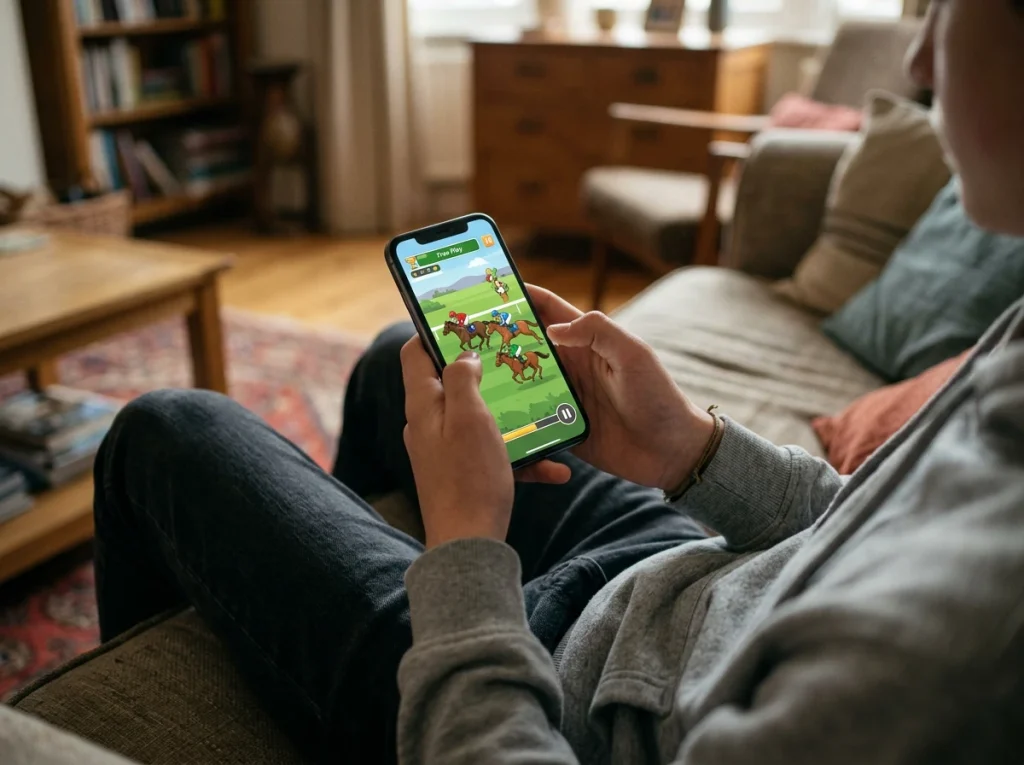
Assessing Gambling Mechanics in Free-to-Play Racing Apps
A friend of mine forwarded me a screenshot last spring — her sixteen-year-old son had installed a free horse racing game from Google Play, and the home screen looked, in her words, “like a slot machine wearing a saddle”. She wanted to know whether she was overreacting. She wasn’t.
I have spent eight years inside this category — virtual sports, RNG audits, simulator apps — and the question of teen exposure is the one I get asked most often by people outside the industry. The honest answer is that free-play horse racing games sit in a regulatory grey zone the UK has not fully resolved. They are not gambling under the Gambling Act, because no real money flows in or out. But the loop on screen — pick, stake virtual coins, race, win or lose, stake again — is structurally identical to the one a Coral or Ladbrokes virtual customer experiences for actual cash.
That structural identity matters more than the cash flag. UK problem gambling research has been pointing at this for years. Around 2.7% of UK adults score eight or higher on the Problem Gambling Severity Index, the threshold for a clinical concern, but the rate climbs to roughly 10% among 18 to 24-year-olds. Dr Lia Nower’s 2023 New Jersey study put problem gambling at 6% across the adult population and 19% in the 18 to 24 band, a gradient so steep it cannot be dismissed as noise. The teen years are where habits set, and the apps are right there in the App Store under “Casino” or “Racing” with a 4+ or 12+ rating.
So no, parents asking this question are not overreacting. They are reading the design correctly. What follows is what I tell them when they ask what to actually check.
The Cash-Out Test From a Parent’s Side
Every time I assess a free-play racing app for a parent, I run what I call the cash-out test in reverse. Normally, in industry, we ask: can a player extract real money from this product? If yes, it is gambling. If no, it is a game. From a parent’s angle, the more useful question is the mirror image: can a player put real money in, and what does that money buy?
Pull up a typical free-play horse racing simulator on a phone and you will see the answer within thirty seconds. There is a coin balance in the top right. There is a button — usually with a plus sign or a gem icon — that opens a store. Inside that store are coin packs at fixed price points: typically £0.99, £4.99, £9.99, £49.99, £99.99. The packs grow exponentially in coin value. The £99.99 pack does not give you 100 times what £0.99 gives you. It gives you 300 to 500 times more, because the pricing curve is designed to push users toward the larger bundles.
That is the cash-out test failing in the direction parents should care about. Real money goes in. Virtual coins come out. Those coins fund pick-and-spin cycles. The coins cannot be withdrawn, exchanged, or even meaningfully transferred. From a Gambling Commission angle this is a closed economy and therefore not gambling. From a behavioural angle, the loop is gambling without the upside. The classification is, as iHorse Betting App version 7.1 from May 2026 puts it in its own store description, that practice or success at this game does not imply future success at real-money gambling. That disclaimer exists because the resemblance is so close the developer has been required to flag it.
What worries me more than the coin store is something subtler — the mechanism by which a teenager learns that a near-miss feels meaningful. In a real Coral virtual race the RTP sits at around 90%, with the operator margin baked into the odds. In a free-play app there is no RTP because nothing pays out. The “win” is a bigger pile of coins that fund more spins. The brain processes both events similarly. That is the part that travels into adulthood, and that is what Dr David Zendle’s University of York team has been studying. His evidence to the UK Commons CMS Committee in 2024 made the point bluntly — social casino play is associated with a transition into traditional gambling later, and the design choices that produce that transition are not accidental.
For a parent the practical takeaway is this: a free coin balance is not free. The store behind it is the business model.
Mechanics That Mimic Gambling Without Being It
The cleanest way to see what these apps are actually doing is to list the mechanics they share with regulated gambling products and the ones they do not. I will keep it concrete because abstractions help no one.
Shared with gambling: random outcomes from a software RNG, fixed odds displayed before the event, variable reward schedules, near-miss effects designed to encourage continued play, escalating stake suggestions, time-pressure cycles between rounds, audio-visual cues tied to wins, daily-bonus mechanics that punish inactivity, and progress meters tied to spending. The cycle in a free-play horse racing app runs at roughly the same tempo as a real Inspired Racing virtual — two to three minutes a round in retail, faster on mobile — which means the rate of decision-making is identical to a regulated product.
Not shared with gambling: no real-money payout, no licensing requirement under the Gambling Act, no UK Gambling Commission oversight, no enforced age gate beyond store-level rating, no affordability check, no GamStop integration, no mandatory cooling-off period, no testing by an accredited lab such as eCOGRA or GLI Europe BV. The Inspired Racing engine that powers Coral’s virtual product must hit an RTP between 80% and 92.1% depending on bet type and must be tested by an approved laboratory. The horse racing app on your child’s phone has none of these requirements.
That asymmetry is the heart of the safety question. The gambling-adjacent design is preserved. The consumer protections are stripped out. From a behavioural psychology standpoint you have built a training environment for gambling habits and removed the guard rails. A teenage user who plays a free-play horse simulator for six months arrives at their 18th birthday already conditioned to the loop and conditioned to spend on it, but without ever having encountered a deposit limit, a reality check, or a self-exclusion option.
One detail that often catches parents off guard: the same studios that build regulated UK virtual products often build free-play apps under different brand names. The animation engines, race physics and odds-display conventions are recycled. This is not by itself sinister — it is software reuse — but it means a child practising on a free-play app is, in a literal sense, practising the muscle memory needed for the real product. The crossover between these two worlds is something I have written about at length in my piece on how social casino mechanics intersect with horse racing simulators, and the structural overlap is more deliberate than most parents assume.
Age Ratings, PEGI and Store Categories
Let me clear up the rating confusion, because it traps a lot of parents. PEGI is the European age-rating system used on console and physical games. Mobile apps in the UK use the IARC system, which assigns PEGI-style labels on Google Play and age categories on Apple’s App Store. The two are related but not identical, and neither rates gambling-style mechanics in a way that captures what a free-play horse racing game actually does.
Under PEGI guidelines, a “Gambling” descriptor is applied to games that simulate or teach gambling. In practice this label is applied inconsistently. The iHorse Betting App, version 7.1, was published on the Apple App Store in May 2026 with a 21+ rating and an “amusement only” disclaimer. That is a self-imposed gate by the developer, not an enforcement by Apple. The Android equivalent, com.nvgamepad.horseracing in the Google Play store, also version 7.1 from May 2026, is published in the Racing category and pairs horse racing simulation with slot-machine mini-games inside the same product. Its age rating on Google Play is lower than Apple’s. Same software. Two stores. Two different age messages to parents.
What store ratings do not check: whether in-app purchases are present, whether the game uses variable-ratio reward schedules, whether there is an unsuppressible ad funnel, whether play history is logged for the user to see. These are the indicators that matter for gambling-adjacent risk, and none of them are visible on the install page.
The UK Commons CMS Committee picked up exactly this gap in 2024. The Committee’s report recommended that the government should review the case for prohibiting children from accessing social casino games — a recommendation that has not yet translated into law but signals where regulatory direction is heading. For now the rating you see on the store page should be treated as a marketing label, not a safety verdict.
Practical Checks Before You Hand the Phone Back
I will keep this concrete. If you are a parent, sit down with the phone for ten minutes and run through these checks. They take longer to describe than to do.
Open the app’s store entry on the device. Scroll to in-app purchases. Note the price ceiling. A £99.99 tier is the signal that the app is monetised through whales — a small fraction of users spending heavily. Teenagers are not the target demographic, but they are accessible to it.
Open the app itself. Find the coin store. Note whether the largest pack is presented with “best value” framing. Note whether the app offers a “watch ad for coins” loop — this is the pattern that drives session length without spending and is the gateway to spending later.
Check Apple Screen Time or Google Family Link settings. Both platforms allow you to require parental approval for in-app purchases. Both allow you to block in-app purchases entirely. On iOS, Settings, Screen Time, Content and Privacy Restrictions, iTunes and App Store Purchases, In-App Purchases, Don’t Allow. On Android, Family Link, the child’s profile, controls, Google Play, require approval for in-app purchases. Setting these once is more effective than any conversation.
Look at session history if the app provides it. Most do not. If yours does, look for daily-bonus streaks — these are designed to lock in habitual returns. A teenager who has logged in twenty-eight days running is being conditioned.
Talk to your child about the cash-out test. Not in a lecture. Ask them what the coins buy, what happens if they win, what happens if they lose. Listen to the framing. If they say “I won £200 of coins last night”, that is the language of gambling without the consequence — and worth a longer conversation.
Where the Risk Actually Lives
The risk in free-play horse racing games for UK teens is not a single villain. It is the cumulative shape of the design. Random outcomes, variable rewards, escalating stakes, and an age window — 16 to 24 — that the research consistently identifies as the most vulnerable to problem gambling onset. The 10% PGSI 8+ rate in 18 to 24-year-olds does not arrive at 18 from nowhere. It builds.
What free-play horse racing apps offer is not a path to real-money loss in childhood. They offer a rehearsal space for the cognitive habits that drive real-money loss in adulthood. The store rating, the disclaimer, and the absence of cash payout do not change the rehearsal. They just remove the consequences while the rehearsal is happening.
A teen who plays these games is not automatically heading for harm. Plenty play casually and move on. But the apps are not designed to encourage casual play. They are designed to maximise session length, return frequency and eventual conversion to paying. A parent who understands that design choice can have a useful conversation. A parent who assumes the store rating reflects safety cannot.
Frequently Asked Questions
Does PEGI rate gambling-style mechanics in a free-play racing game?
PEGI applies a Gambling descriptor when a game simulates or teaches gambling, but enforcement is inconsistent on mobile. Most free-play horse racing apps in the UK avoid the descriptor because no real money pays out, even though the underlying loop mirrors a regulated virtual product. Treat the store rating as a marketing label, not a safety verdict.
Should I worry about ads inside a free-play horse racing game?
Yes. The "watch ad for coins" pattern is a primary driver of session length and conditions the user to associate viewing with reward. Many of these ads themselves promote other social-casino products, creating a funnel toward more gambling-style apps. Ad-heavy free apps are usually worse than the ones with paid upgrades.
Can I set Apple Screen Time or Google Family Link to block coin purchases?
Yes, both platforms support this. On iOS go to Settings, Screen Time, Content and Privacy Restrictions, then disable In-App Purchases. On Android use Family Link to require parental approval for any Play Store purchase. Setting this once is more effective than any single conversation about spending.
Articles
Created by the "Horse Racing Bet Game" editorial team.
