
Glossary of a Horse Racing Betting Game
 Available in US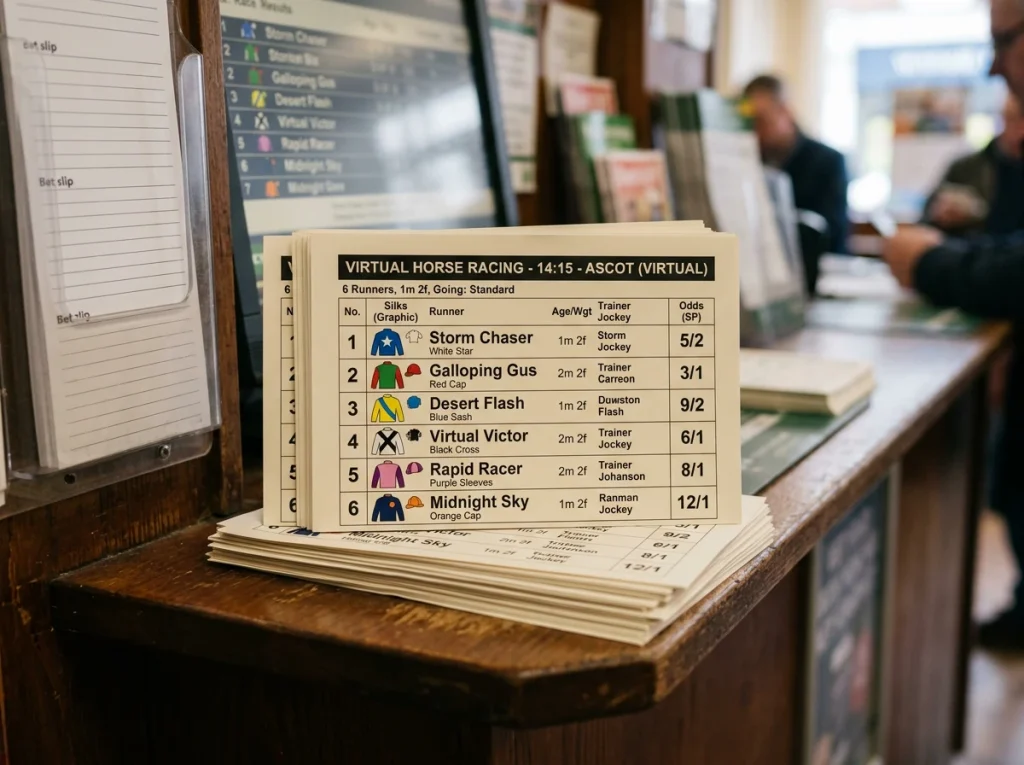
A Working Glossary, Not a Dictionary
I have written a lot of glossaries over the years for clients who wanted simple definitions of complex things. The ones that worked were the ones that explained what each term means in the context of a real customer trying to use the product. The ones that did not work were the ones that read like a dictionary entry transplanted from a textbook. This is meant to be the first kind.
UK virtual horse racing brings together terminology from three different worlds. Technical vocabulary from the engineering side — RNG, RTP, cycle, overround. Bet-type vocabulary from the betting traditions of two continents — Win and Each-Way alongside Exacta and Trifecta. Regulatory vocabulary from the UK framework — UKGC, LCCP, RTS, GamStop. And supplier vocabulary that names the B2B vendors whose engines power the products customers actually see — Inspired Entertainment, Playtech Virtual Sports, Mohio Gaming, SIS. A customer using the product encounters terms from all four worlds within a single session.
The Inspired Racing RTP band of 80% to 92.1% across bet types and the typical UKGC requirement for eCOGRA or GLI Europe BV certification are not abstract industry facts. They are the technical and regulatory backdrop against which every term in this glossary acquires meaning. A “cycle” of three minutes matters because it sits inside a regulatory framework that defines what reality checks and deposit limits must accompany a continuous-cycle product. An “overround” of 10% matters because it translates directly into an RTP figure within a band certified by an approved lab.
What follows is the working vocabulary, grouped into four families. Each definition explains what the term means and why it matters in practice. As one industry editorial summary captured it, virtual horse racing is fundamentally a fully RNG-driven fixed-odds product, and most of this glossary is the working language that describes how that product behaves.
Technical Terms: RNG, RTP, Cycle, Overround
RNG — Random Number Generator. The software component that produces the random sequence on which every race outcome depends. In a UK regulated virtual horse racing product, the RNG must be certified by an approved testing lab — eCOGRA or GLI Europe BV — against the UKGC’s Remote Technical Standards. The RNG sits at the engineering foundation of the product. Every visible race result derives, ultimately, from numbers the RNG produced. The certification confirms that the RNG behaves with sufficient statistical randomness across long sequences and that its outputs cannot be predicted or manipulated.
RTP — Return to Player. The long-run percentage of staked money the product returns to customers in aggregate. A 90% RTP means that across very large numbers of bets, customers receive back roughly 90% of what they staked. The other 10% is the operator’s margin. RTP is not a guarantee for any individual session — variance can produce significantly better or worse outcomes over short periods — but it sets the long-run mathematical expectation. Different bet types within the same product often run at different RTP positions inside the certified band, with Win bets typically at the top and exotic markets toward the floor.
Cycle — The time between the start of one virtual race and the start of the next. Cycle lengths vary by supplier and operator configuration. William Hill runs at five minutes per cycle. Mohio runs at three minutes on six-runner cards and four minutes on eight-runner cards. Inspired runs at two to three minutes. Paddy Power runs at two minutes. The cycle is the rhythm of the product. Shorter cycles compress customer decision-making and amplify the responsible-play challenge.
Overround — The percentage by which the book on a virtual race sums above 100%. A book summing to 110% has a 10% overround, which is roughly equivalent to a 90% RTP on Win bets. The overround is the operator’s margin expressed as a market percentage. On UK regulated virtual products, the overround is configured at the operator level within the supplier’s certified band, and it is fixed for each race the moment the card is generated.
Implied probability — The probability of a particular outcome implied by its displayed odds. Decimal odds of 5.0 imply a 20% probability, calculated as 1 divided by 5. Adding the implied probabilities across all runners on a card gives the book total, which equals 100% plus the overround. Implied probability is the most directly readable signal on any virtual card.
Fixed odds — Betting at a price set by the operator before the event, where the customer’s return is locked at that price regardless of subsequent market movement. Virtual horse racing is a fixed-odds product because the operator stamps the odds onto the card at generation and they do not move before the off. This is structurally different from exchange betting on real racing, where odds change continuously based on money flow.
Bet-Type Terms: Win to Trifecta in Plain English
Win — Pick the runner to finish first. The simplest market. Stake multiplies by the displayed odds on a winning bet, loses entirely on any other outcome.
Place — Pick the runner to finish in the top places, where the number of places paid depends on field size. Typically top two on six-runner cards, top three on eight-runner cards. Place bets pay at the full displayed Place odds on a winning outcome.
Each-Way — Two bets in one stake: half on Win, half on Place. The Place portion typically pays at one-fifth of the Win odds on UK virtual products. Each-Way protects the customer if the runner places without winning, but the structure is only profitable on placed-not-won outcomes when the runner is priced longer than around 6/1 with one-fifth place terms.
Forecast — UK-named bet asking for the first two finishers in exact order. Straight Forecast requires the exact ordering. Reverse Forecast covers both orderings at double the stake. Forecast bets are settled at a synthetic dividend the operator calculates from implied probabilities on virtual products.
Tricast — UK-named bet asking for the first three finishers in exact order. Settled at a synthetic dividend. The market typically sits at the floor of the supplier’s RTP band, with overround thicker than on Win or Each-Way bets.
Exacta — US-named equivalent of Straight Forecast. Pick the first two in exact order. On a UK virtual product offering both Forecast and Exacta, they pay the same dividend for the same outcome because they are mathematically the same bet.
Quinella — US-named bet covering the first two in any order at a single combined stake. Functionally similar to a Reverse Forecast but with different stake handling. The Quinella pays a blended dividend across both orderings rather than the half-stake-each structure of the Reverse Forecast.
Trifecta — US-named equivalent of Tricast. Pick the first three in exact order. Mathematically equivalent to the UK Tricast on UK virtual products, with the same synthetic-dividend calculation.
Box — A stake-handling instruction that covers every possible ordering of the runners selected. A Boxed Trifecta covers six orderings for three horses, twenty-four for four horses, sixty for five horses. The total stake multiplies by the number of orderings.
Reverse Forecast — Covers both orderings of a two-runner Forecast at double the base stake. Pays the full Straight Forecast dividend on the half-stake that wins.
Dividend — The return on a winning Forecast, Tricast or US-named exotic, calculated by the operator at settlement from the implied probabilities of the runners involved. On virtual products the dividend is synthetic rather than pool-driven.
Regulatory Terms: UKGC, LCCP, RTS, GamStop
UKGC — UK Gambling Commission. The British regulator responsible for licensing and supervising gambling operators that serve UK customers. Every UK regulated virtual horse racing product operates under a UKGC operating licence. The Commission can grant, vary or revoke licences, sets technical and operational standards, and publishes enforcement actions against operators that breach requirements.
Combined Remote Operating Licence — The UKGC’s single licence covering remote gambling activity by an operator. The “Combined” element consolidates what were previously separate licences for sports betting, casino and other verticals into a single permission with vertical-specific conditions. Virtual horse racing sits inside the licence as a betting product, even though its mechanics resemble a casino product.
LCCP — Licence Conditions and Codes of Practice. The detailed document setting out what licensed operators must do, must not do, and must put in place to protect customers. The LCCP covers social responsibility, anti-money-laundering, advertising standards, customer interaction, and many other operational areas. It applies to virtual sports the same way it applies to any other regulated product.
RTS — Remote Technical Standards. The technical specification document covering how regulated gambling systems must behave. The RTS contains the section that governs RNG behaviour for products like virtual horse racing — the statistical properties the RNG must demonstrate, the testing requirements, the audit trail obligations.
GamStop — The UK’s national self-exclusion scheme. Every UKGC-licensed operator is required to participate. A single registration excludes the customer from every regulated UK gambling site for a chosen period of 6 months, 1 year or 5 years. The exclusion cannot be reversed before the chosen period ends.
Affordability check — A financial vulnerability review triggered when a customer’s net monthly deposits exceed defined thresholds. The light-touch check applies at 150 pounds net deposits per month, reduced from 500 pounds in February 2025. Enhanced checks at higher activity levels may require documentation including proof of income or bank statements.
Remote Gaming Duty — The UK tax on operator gross gaming revenue from remote casino-equivalent products including virtual sports. The rate rose from 21% to 40% on 1 April 2026, materially affecting operator margins on virtual horse racing.
Approved test house — A testing and certification body approved by the UKGC to verify compliance of gambling products against the Remote Technical Standards. eCOGRA and GLI Europe BV are the most prominent approved labs for UK virtual sports certification.
Supplier Terms: Inspired, Playtech, Mohio, SIS
Inspired Entertainment — The largest single supplier of virtual sports content into the UK market, with virtual horse racing distributed across multiple UK retail and online operators. The Inspired Racing engine publishes an RTP band of 80% to 92.1% across bet types. The company reported Q4 2025 EBITDA margin of 42% with the interactive division up 53% in revenue and 60% in EBITDA year-on-year, and Q1 2026 total revenue growth of 29%. Inspired also extends internationally — its February 2026 launch into the Turkish market through the Gametech MediaHub deal bundled Virtual Horse Racing and Greyhound Racing into one content package.
Playtech Virtual Sports — The supplier behind the Coral retail and online virtual horse racing product, with related content reaching the Ladbrokes brand under the same operator group. The Coral Playtech engine runs at a flat 90% RTP on its UK virtual horse racing offering.
Mohio Gaming — A smaller supplier with a particular focus on retail virtual sports. The Mohio engine’s three-minute cycle on six-runner cards and four-minute cycle on eight-runner cards is tuned for the rhythm of UK betting shops between real-race meetings.
SIS — Sports Information Services. A long-standing supplier of retail content including the 49s product alongside virtual racing. SIS distributes content through retail terminals and overhead screen feeds, combining the data-and-content infrastructure role with the underlying racing product. The full structure of how SIS’s 49s product fits into the broader UK retail virtual mix is something I cover in my piece on the UK virtual horse racing house edge and how RTP figures translate into customer-facing economics — see RTP and house edge in virtual horse racing.
Frequently Asked Questions
What is the single most important term in this glossary?
RTP — return to player. It is the number that translates everything else in the glossary into a long-run expected economic outcome for the customer. A 90% RTP means roughly 10% of staked money is, in long-run terms, the operator"s margin. Every other term — cycle, overround, certified band, lab certification — exists to describe how that RTP is produced, governed and verified.
What is the difference between a cycle and a round?
They are often used interchangeably but they describe slightly different things. A cycle is the time between the start of one race and the start of the next, including the build-up, betting window, race animation and settlement. A round is sometimes used to mean just the race event itself rather than the full cycle. In practice the two terms are usually safe to treat as synonyms in a UK virtual horse racing context.
Why do UK and US bet-type terms mix on the same menu?
UK virtual horse racing products are built by global suppliers — Inspired, Playtech, Mohio, SIS — and the bet menus inherit naming conventions from multiple markets to support distribution across both UK and US-facing operators. The result is that a UK customer sees Forecast next to Exacta and Tricast next to Trifecta on the same card. The bets are mathematically equivalent across the dual notation in most cases.
Articles
Prepared by the Horse Racing Bet Game editorial staff.
