
Mobile Horse Racing Betting Apps for UK Punters
 Available in US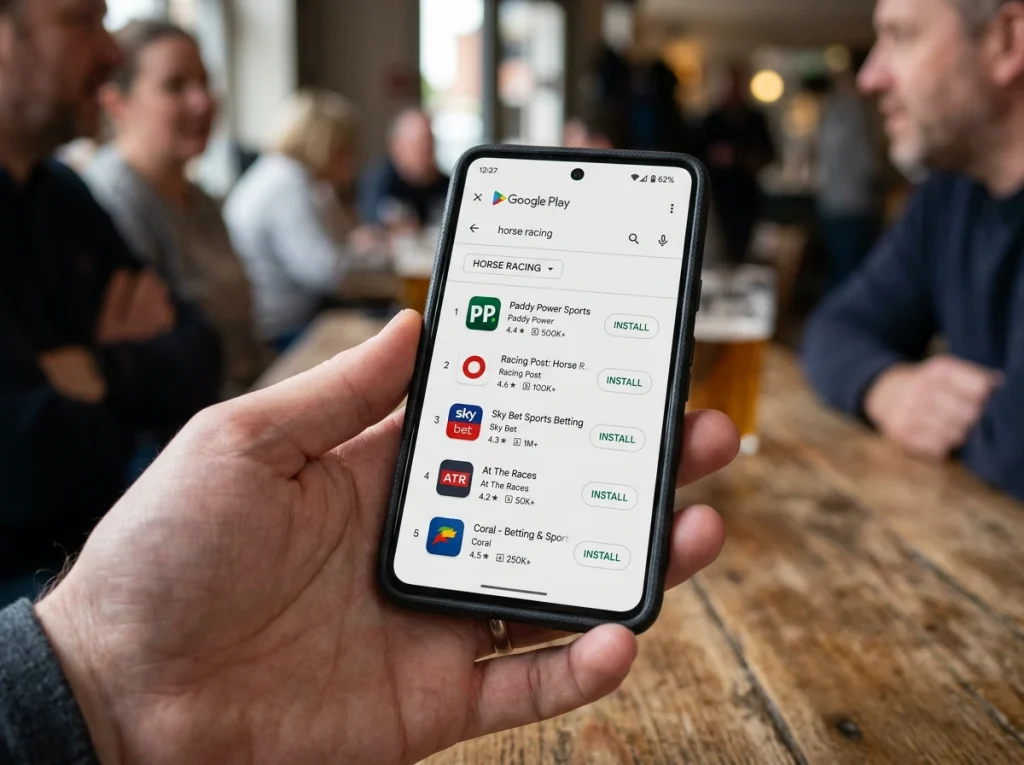
Comparing Free-Play and Real-Money Mobile App Features
If I open the App Store on my own phone right now and search “horse racing”, the results are a mix that would have confused any pre-2018 punter. The first four results are real-money UKGC-licensed bookmaker apps with virtual horse racing buried inside their products. The next six are free-play simulators with cartoon horses and coin economies. They all share the search results page, the same icon grid, the same install button. The store does almost nothing to help the user distinguish between them.
This is the structural picture of mobile horse racing betting apps in the UK in 2026. Two parallel catalogues exist on every smartphone the country uses. One is the regulated catalogue — real-money apps behind a UKGC licence, with affordability checks, GamStop integration and certified RNGs. The other is the free-play catalogue — entertainment apps with no real-money payout, no licence requirement, and no equivalent consumer protections. They look superficially similar from the install page. They are governed by entirely different rules.
The market context is that around 71% of smartphone users globally now have ready access to gambling-style content through their handset, and the iHorse Betting app, version 7.1 of which launched in May 2026 on the Apple App Store, carries its own “amusement only” classification to signal that practice or success at the game does not imply future success at real-money gambling. The Google Play equivalent under the package com.nvgamepad.horseracing reached version 7.1 in the same month and combines horse racing simulation with slot mini-games inside a single product.
What follows is a practical map of these two catalogues for a UK user trying to understand what they are downloading, what regulatory layer sits behind it, and what the visible differences are at the install screen.
Real-Money Apps: Behind the UKGC Filter
Real-money mobile gambling apps in the UK are subject to the same Combined Remote Operating Licence framework as the operator’s website. The app is, technically, a wrapper around the operator’s gambling platform. Every regulatory requirement that applies to the website applies to the app. The Licence Conditions and Codes of Practice cover the app’s behaviour. The Remote Technical Standards apply to any RNG-based product inside it, including virtual horse racing. GamStop integration applies to the customer’s login state regardless of whether they reach the operator through the app or the browser.
What the app adds, in user-experience terms, is a more direct access route. The customer’s identity is bound to the device through the operator’s authentication. The deposit interface is one tap away. The push notification permission, once granted, allows the operator to surface promotional and product content directly to the lock screen. Each of these features increases engagement, which is precisely why operators invest in app development — but each also amplifies the responsible-play challenge for users prone to impulsive activity.
App stores apply their own additional layer of rules on top of the regulator’s. Apple’s App Store gates real-money gambling apps by territory — a real-money UKGC-licensed app appears in the UK store but may not appear in App Stores for territories where the operator does not hold the relevant gambling licences. The customer experience can be confusing when a user travels: opening the same App Store account in a different country can hide gambling apps the user previously had access to. The apps themselves remain installed on the user’s device but new installs and updates may behave differently across borders.
Google Play applies a similar gating mechanism but with looser overall rules. Real-money gambling apps appear in Google Play in the UK when the operator has both the UKGC licence and Google’s separate developer approval for gambling content. The approval process at Google’s end is its own gate, and not every UKGC-licensed operator has chosen to pursue it. Some major UK brands offer their real-money product as a web-app rather than a native Google Play installation, which is a routing choice rather than a regulatory limitation.
A virtual horse racing customer using a real-money mobile app encounters the same product as the website version. The cycle speed, the RTP band, the GamStop coverage and the affordability checks all apply identically. The mobile interface compresses the experience into a smaller screen and faster taps, but the underlying compliance framework is identical to the desktop version.
Free-Play Apps: A Parallel Catalogue
The free-play catalogue is the larger of the two by sheer count. Open either store and search horse racing terms; the majority of results are free-to-install apps with virtual currency economies. These products are not gambling under UK law because no real money flows out of the app. They do not require UKGC licensing. They are governed by the app stores’ rules and by general consumer protection law, but not by the gambling-specific framework.
The iHorse Betting App version 7.1, launched in May 2026, is the clearest established example. It is published on the Apple App Store with a 21+ rating and an “amusement only” classification. The package com.nvgamepad.horseracing on Google Play reached version 7.1 the same month and is published in the Racing category. The Apple version and the Google version are the same underlying software with different age framing on their respective stores. The disclaimer that practice or success at iHorse Betting does not imply future success at real-money gambling, and that the developer does not manipulate game outcomes, is the developer’s own framing in response to the resemblance between their product and regulated gambling.
Beyond iHorse, the free-play catalogue includes a long list of products from independent developers — racing simulators with arcade physics, themed reskins of slot mechanics with horse racing dressing, and crossover products that combine horse racing rounds with classic casino game-loops. These are reviewed in detail in my piece on free-play horse racing simulator apps, including their pricing structures and behavioural patterns.
The key practical distinction for a UK user is the cash-flow direction. Money goes into a free-play app via in-app purchases of virtual currency. Money does not come out. The app cannot pay out winnings as cash, because doing so would convert it into a gambling product requiring a UKGC licence — which the app does not hold. This is the structural firewall that keeps the free-play catalogue outside gambling regulation. It is also the structural reason free-play apps have to monetise through coin sales and ad watching rather than through margin on player losses.
Installs, Permissions and Deposit Flows
The install process for a real-money gambling app in the UK is meaningfully different from a free-play one, and it is worth knowing what to expect.
For a real-money app, the install itself is fast. The bottleneck is account onboarding. After the install, the user is asked for full identity details — name, date of birth, address, contact details — and the operator runs the same identity verification stack that a website registration would trigger. Many operators verify identity electronically against credit reference data and electoral roll data, completing the check within minutes. Where the electronic check fails, the operator falls back to document upload — typically passport, driver’s licence or utility bill. The user cannot deposit until verification is complete.
Deposit flows in real-money apps are bound by UKGC payment rules. Credit cards have been banned for gambling deposits in the UK since April 2020, so the app’s accepted payment methods are debit cards, certain e-wallets, and bank transfers. The deposit interface tracks against affordability check thresholds — the 150 pound monthly net deposit trigger for the light-touch check applies regardless of whether the customer reaches the operator through the app or the website.
For a free-play app, the install process is faster and lighter. No identity verification. No age verification beyond the store-level rating. The user can play within seconds of installing. The first in-app purchase — typically a coin pack — triggers the standard App Store or Google Play purchase flow, which uses the user’s existing payment method on file with the store. The gambling operator’s payment compliance framework does not apply because the purchase is processed by the store, not the operator. This is why parental controls on Apple Screen Time or Google Family Link, which can restrict in-app purchases at the store level, are the practical protection for younger users.
Push notification permissions are a third area worth attention. Real-money apps use push notifications for promotional offers, results notifications and account alerts. The operator must comply with marketing communication rules, including allowing the user to opt out of promotional notifications while retaining account-essential ones. Free-play apps use push notifications more aggressively because re-engagement is their core monetisation lever. A teenager who installs a free-play horse racing app and accepts default notification permissions will receive recurring prompts to return to the game, which is the design intent.
What Apple and Google Actually Allow
Both stores publish detailed policies on gambling content, but they apply those policies differently in practice. Understanding the broad framework helps a UK user spot what is and is not regulated.
Apple’s App Store treats real-money gambling apps as a regulated category requiring developer registration as a gambling provider, jurisdiction-specific approval, and age-gating. The store enforces a 17+ minimum age rating for real-money gambling apps and restricts their visibility to App Stores in jurisdictions where the developer holds appropriate licensing. Apple also requires real-money apps to use the App Store’s review process for any updates that affect gambling functionality, which produces a longer release cycle than non-gambling apps experience.
Google Play applies a broadly similar framework but with some differences in execution. Real-money gambling apps require both the underlying jurisdictional licence — the UKGC licence for UK distribution — and Google’s separate developer approval. The age-rating threshold on Google Play for real-money gambling is currently 18+, and visibility is gated by country and by Google’s approval of the specific app. Where Google has not approved a particular app, the operator can choose to deliver the same functionality through a web-app installation, which sits outside the Play Store’s policy framework.
Free-play apps face lighter store-level scrutiny but are still subject to the stores’ broader content rules. Both stores prohibit apps that simulate gambling with real-money outcomes outside the regulated framework. Both stores allow apps that simulate gambling-style mechanics with virtual currency that has no cash value. The line between the two is what allows the free-play horse racing catalogue to exist on the stores at all.
For a UK user, the practical implication is that a real-money app reaching your store search results has passed multiple regulatory and platform gates — UKGC licensing, store-level approval, jurisdiction matching. A free-play app reaching the same search results has passed a single gate: the store’s content policy. This is not, in itself, a value judgement. It is a description of the regulatory weight behind each product.
Frequently Asked Questions
Why does Apple App Store list real-money racing apps in fewer countries than free-play?
Real-money gambling apps require jurisdiction-specific licensing — the UKGC licence for UK distribution, and equivalent licences for each other country where the app appears. Apple gates visibility of these apps to App Stores in territories where the operator holds the relevant licence. Free-play apps do not need gambling licensing because no real money pays out, so they can appear in every territory where the App Store operates without territorial gating.
How does a UK punter spot a real-money licensed app on Google Play?
The app"s developer name will match a known UKGC-licensed operator, the store listing will display an 18+ age rating, and the description will reference real-money betting and account-deposit functionality. Free-play apps describe themselves explicitly as "amusement only" or "not real-money gambling", and their store rating is usually lower than 18+. When in doubt, check whether the app references a UKGC licence number in its listing.
Are push notifications from a racing app a responsible-play concern?
They can be. Real-money apps must comply with marketing rules that allow opt-out of promotional notifications. Free-play apps use push notifications more aggressively because re-engagement is their primary monetisation lever. For both categories, the responsible-play option is to disable notifications at the operating system level after install, regardless of what the app"s settings offer.
Articles
Created by the "Horse Racing Bet Game" editorial team.
