
Free-Play Horse Racing Simulator Apps for UK Devices
 Available in US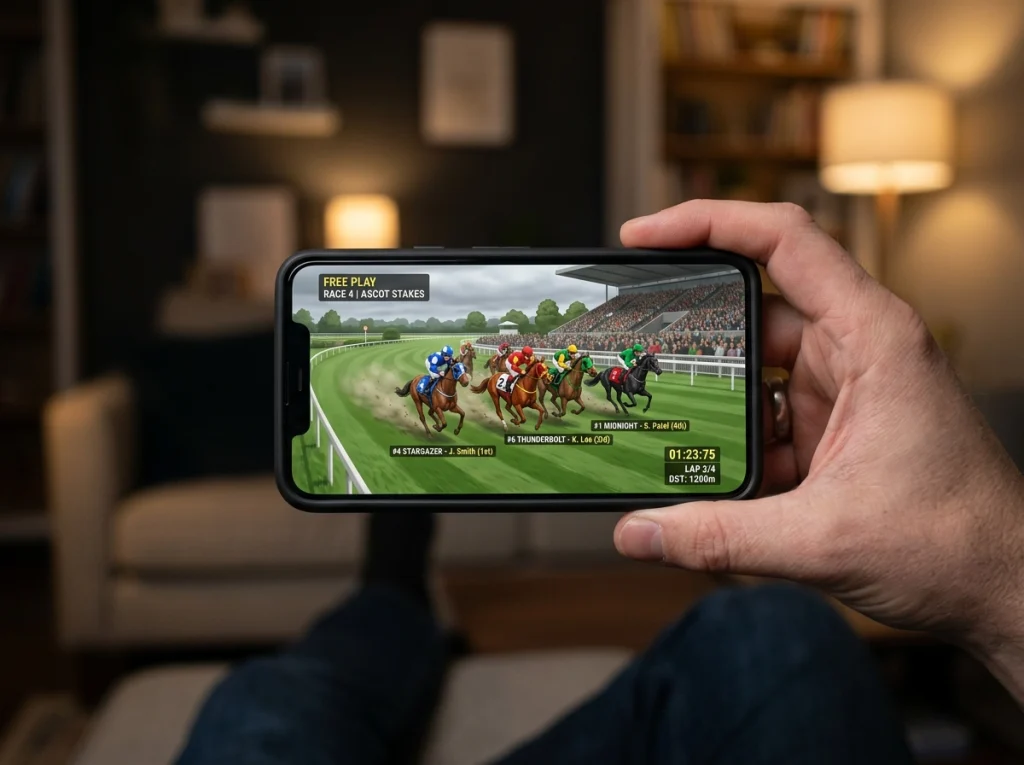
Evaluating Virtual Simulator Age Ratings and Mechanics
A reader emailed me last spring asking whether the horse racing simulator she had been playing on her phone every evening for a month was “actually gambling”. She had not deposited any real money. She had not won any real money. She was, by every measure she could see, playing a game. And yet the experience — the displayed odds, the silks, the commentary, the slowly increasing impatience for the next race — felt indistinguishable from sitting in a betting shop. Her instinct was right. The experience is engineered to feel identical. The legal classification is what makes the two different.
“Free-play” horse racing apps in the UK sit in a regulatory category that requires precise wording. Under the Gambling Act 2005, a product is gambling if the player can win a prize of money or money’s worth. If the only thing a player can win is in-game currency that cannot be exchanged back for real money, the product is a game, not gambling. That single test — cash-out or no cash-out — separates the App Store and Google Play catalogue of horse racing simulators from the UKGC-licensed virtual racing products at Coral, Paddy Power, William Hill and their peers.
The classification matters because it determines almost everything else. UKGC has no jurisdiction over a product that cannot pay real money. The free-play product does not need an operating licence, an RNG certification from eCOGRA or GLI, an affordability check infrastructure, a deposit limit framework, or GamStop integration. It needs an age rating from the app store, a payment relationship for in-app purchases, and reasonable disclaimers. That is a substantially lower regulatory bar.
It is also, paradoxically, a higher consumer-protection bar in one specific way. The free-play product cannot take real-money bets. The worst financial outcome for a punter is exactly equal to whatever they spent on in-app coins. The harm vector is different from regulated gambling, but it is not zero — particularly for users who develop a habit on a free-play product and then transition to a real-money UKGC-licensed alternative. That transition risk is the part I want to spend time on.
The Titles UK Users Actually Open
The UK free-play horse racing app landscape clusters around a handful of recognisable titles. None of them are licensed by UKGC, all of them are available to UK adults via the standard app stores, and each one occupies a slightly different design space.
iHorse Betting, published by Gamemiracle Company Ltd, is the most prominent of the mobile titles. Currently at version 7.1 — released in May 2026 on iOS — the app describes itself as the most realistic horse betting simulator on the market. The user interface borrows heavily from real bookmaker apps: silks, runner numbers, displayed odds, a betting window that closes before the race. In-game currency is the betting medium. Players buy coins with real money. Coins cannot be converted back. The Apple App Store category is “21+ for amusement purposes only”, an unusual rating shaped by the app’s resemblance to gambling rather than by any actual gambling risk to the player. We unpack iHorse’s design in detail in our piece on the iHorse Betting app.
Silvergames hosts a browser-based horse racing simulator at silvergames.com — free play, no download, HTML5/WebGL. The product is rated for ages 6 and over, gives a $100 virtual starting balance, and offers Win, Place and Show bets in US notation. Strip away the US framing and the product is a textbook example of free-play virtual racing built for casual browser users with no real-money intent.
plays.org runs a similar HTML5 simulator with a slightly more developed “How to play” educational layer. The bet types catalogue — Win, Place, Show, Exacta, Trifecta, Superfecta, Box — leans American, which limits its UK educational value. The product is offline-cacheable, ad-supported, and explicitly disclaimed as no-real-money entertainment.
Beyond those three, the Microsoft Store carries Windows-native horse racing arcade titles that fall into the same regulatory bucket — free-play, no cash-out, no UKGC oversight, 3D graphics, casino-category framing. The Google Play app catalogue includes a free racing-plus-slots hybrid published under the bundle ID com.nvgamepad.horseracing, with version 7.1 released in May 2026 — racing animation combined with slot-machine bonus mini-games inside the same app, an unusual format that sits squarely in the social-casino design space.
For UK users, the menu is real but the regulatory categorisation is consistent: every title named here is a game, not gambling, and none of them deliver real-money outcomes.
Where the Money Goes (Even When the Game Is Free)
The “free” part of free-play needs more interrogation than the marketing language gets. None of these apps run as charity. The monetisation models cluster around three patterns: ad-supported, in-app purchase, and hybrid.
Ad-supported apps — typical of the browser-based simulators like Silvergames and plays.org — make their revenue from display advertising surrounding the game and, in some cases, from interstitial ads between race rounds. The user pays nothing directly. The economics rely on volume and on the advertising relationships the host platform maintains. UK users in 2026 typically see a mix of unrelated consumer ads, mobile-game promotion ads, and occasionally regulated-gambling ads where the advertiser has paid for placement targeting an adult audience.
In-app purchase models — typical of iHorse Betting and similar mobile titles — sell virtual currency packages directly. A typical iHorse Betting coin package might offer increasing returns per pound spent (a “starter pack” at one ratio, a “value pack” at a better ratio, a “high-roller pack” at the best ratio). The structural design borrows directly from social-casino games and freemium mobile titles. The pricing tiers are set to encourage progressive purchase escalation.
The hybrid model — common in the Google Play catalogue and on smaller titles — combines ad-supported free play with optional purchases. Players can grind coins through gameplay or accelerate progression with purchases. The same design pattern appears in slot-machine bonus mini-games inside racing apps, where the bonus mechanic is the conversion engine pushing free-play users toward in-app spend.
Gamemiracle’s own disclaimer, in the App Store description of iHorse Betting, captures the spirit of the category: practice or success in this game does not imply any success at real money gambling; results are based entirely on luck and the choices made by players in the tournaments. That language is the product’s regulatory shield. It is also, for the punter who reads it carefully, an honest description of what they are buying — entertainment, not transferable skill.
What You Learn About Real Racing — and What You Do Not
Free-play horse racing apps are sometimes marketed as a “safe way to learn how betting works”. I would be careful with that framing. They teach some things accurately and others misleadingly.
The accurate teachings are the mechanics of bet types. A player who places enough Win, Place, Each-Way, Forecast and Tricast bets on a free-play app will internalise the difference between those market structures. The settlement logic of an Exacta versus a Quinella, the way Each-Way splits a stake across two parts, the multiplier effect of a Tricast combination — these are learnable concepts and the simulators teach them functionally. A UK punter who graduates to a regulated virtual racing product after a few hundred rounds of free-play has a head start on the language.
The misleading teachings are around variance and bankroll. Free-play apps typically give the player a refilling currency pool. Run out of coins, watch an ad or wait an hour, get topped up. Real-money virtual racing has no such mechanism — once the deposit is gone, it is gone. A player who has spent a hundred hours seeing their virtual bankroll refilled has not built the emotional muscle to handle the moment when a real-money bankroll empties without coming back. That mismatch is one of the documented risk transitions from social-casino-style play to regulated gambling.
Research published in Sage Journals on platformised gamble-play points to the same transition risk: longitudinal data shows social-casino-app users disproportionately moving on to traditional gambling, with spending on social-casino games correlating with subsequent gambling problems. That research was cited by Dr David Zendle, lecturer in Computer Science at the University of York, in evidence to the UK Culture, Media and Sport Committee. The mechanism is not that free-play is dangerous in itself. It is that free-play normalises the rhythm and surface emotions of betting without ever letting the player practise the part that matters most — handling losses that do not come back.
The Under-18 Question
Apple and Google rate free-play horse racing apps with a mix of approaches that complicate the question of under-18 safety. iHorse Betting carries a 21+ rating on the App Store — unusual and arguably more restrictive than UK norms, where the gambling-related threshold is 18. The 21+ figure is a US-origin convention applied globally. It is not, formally, a UK gambling age restriction. It is an app store choice that limits the listing’s visibility to under-21 users on iOS.
Other free-play titles rate substantially lower. Silvergames rates its horse racing browser game for ages 6 and over. The product contains no overtly age-restricted material, has no in-app purchases, and is purely entertainment. The age rating reflects the absence of restricted content rather than any judgement about its appropriateness.
The risk that the CMS Committee flagged in 2024 is structural rather than content-based. Adults and adolescents who play social-casino games are more likely to go on to engage in traditional forms of gambling, the committee found, and they recommended that the government review the case for banning children’s access to social-casino games. That recommendation has not yet translated into law, but it sits in the policy queue.
For UK parents, the practical question — should I let my teenager play this? — has no single right answer. The free-play product is not gambling. The product is, in some cases, structurally similar to gambling in ways that may build habits. Apple Screen Time and Google Family Link both offer in-app purchase blocks that prevent a teenager from spending real money inside a free-play app, which addresses the direct financial risk. The behavioural risk — habituation to the betting rhythm — requires a different intervention and ultimately involves conversation rather than software.
Is a free-play horse racing app rated 21+ even legal on a UK App Store?
Yes. The 21+ rating is an Apple App Store classification, not a UK legal restriction. It limits the app"s visibility to under-21 iOS accounts but does not reflect any UK gambling law constraint. The product itself is not gambling under UK law because no real-money prize can be won, and is therefore not regulated by UKGC.
Do free-play horse racing apps share data with real bookmakers?
Most do not have direct commercial data-sharing relationships with UKGC-licensed bookmakers. Standard advertising data flows may occur where the publisher uses third-party ad networks, and gambling-adjacent advertisers may target free-play app audiences, but a free-play app does not typically feed user behaviour into a real-money bookmaker"s targeting system in any direct way.
Can a UK punter practise real strategies on a free-play horse racing app?
They can practise the mechanics of bet types and market structures, which transfer. They cannot practise the variance and bankroll discipline of real-money play, because the currency pool typically refills and the emotional weight of irreversible loss is absent. A free-play app teaches the language of betting, not the discipline of it.
Articles
Created by the "Horse Racing Bet Game" editorial team.
