
Each-Way Betting Tactics for Virtual Horse Racing
 Available in US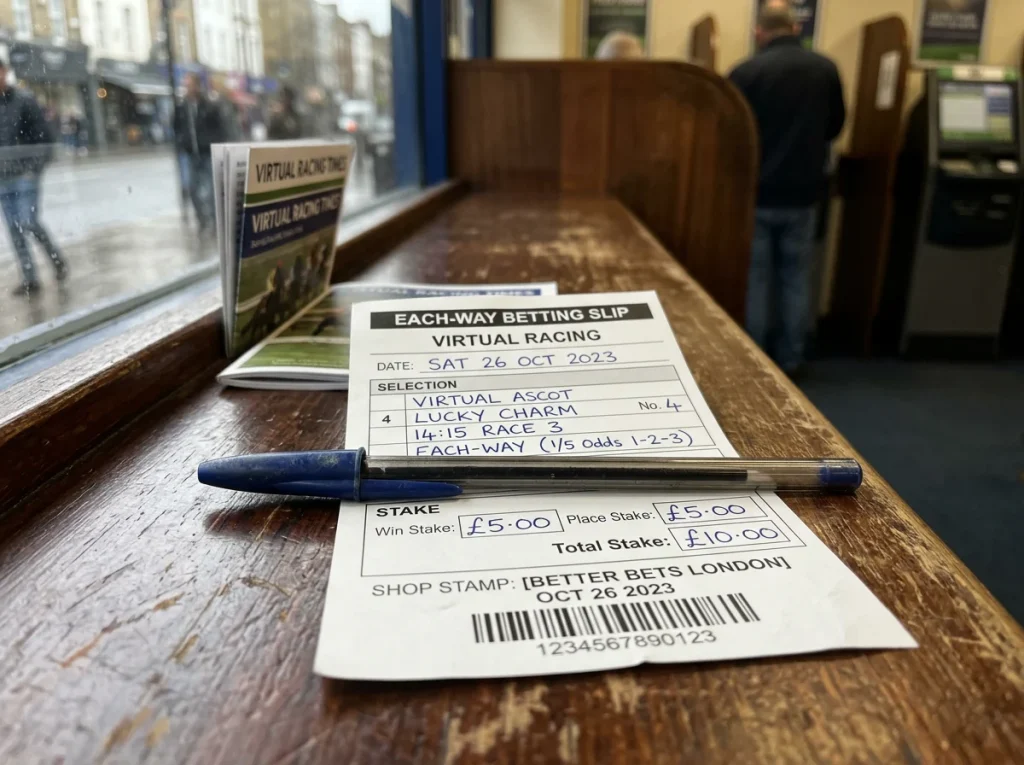
Analyzing Place Fraction Adjustments on Virtual Cards
The first time I ran a bankroll comparison between real-race each-way and virtual each-way using identical staking, I got a result I had not expected. The virtual side lost about twelve percent more over the same number of rounds. The horses were not the problem. The maths was.
Each-way on a virtual horse race uses the same two-bet structure UK punters grew up with — one stake on the horse to win, one stake on the horse to place — but the numbers underneath the ticket sit in a different place. The place fractions are compressed. The runner thresholds are stricter. And because the RTP is baked into the fixed odds on a virtual product, there is no room for the kind of value hunting that occasionally rewards each-way punters in the real-race market. As one industry summary puts it, virtual horse racing is a fully RNG-driven fixed-odds product where the book is constructed before the race begins. Each-way on virtual is therefore a bet against a pre-stamped probability set rather than against a live market reacting to money.
That distinction sounds academic. It is not. It changes how the format should be used. The Inspired engines that power most UK virtual cards publish an RTP band of 80% to 92.1% across all bet types, and each-way sits in the middle of that band. The Coral product, built on the Playtech engine, hits a flat 90% across its virtual cards. Neither of these numbers reflects the place-side payout the way an experienced each-way punter assumes. The place fraction does the heavy lifting on virtual, and the place fraction is where the format is least generous.
What follows is the full mechanic, with worked examples and the comparisons to real each-way that actually matter when you sit down to use the format.
How Each-Way Works on a Virtual Card
The structure of an each-way bet is unchanged from real racing. You stake one pound each-way. That is two pounds total. One pound runs as a Win bet. The second pound runs as a Place bet, where “place” is defined by the operator’s place terms for that race. The Place portion pays out at a fraction of the Win odds — typically a fifth or, less commonly on virtual, a quarter.
What changes on virtual is the source of the odds. On a real race the odds move continuously up to the off, reflecting money flowing in and out of the market. On a virtual race the odds are stamped onto the card at the moment the race generates and remain fixed for the entire two or three-minute window before the off. The operator’s pricing system has set the book to a target overround — typically around ten percent on a UK virtual eight-runner field — and the each-way fraction is part of how the book is constructed. The place fraction is not a courtesy. It is a margin tool.
To see how this plays out, consider a horse priced at 10/1 on a virtual card. The Win side of an each-way bet returns ten pounds plus stake for a one pound stake. The Place side, at one-fifth odds on a three-place card, returns two pounds plus stake. If the horse wins, both halves pay — twelve pounds plus the two pounds staked back. If the horse places second or third without winning, only the Place side pays — two pounds returned, the Win side lost. The total in the second case is two pounds plus the one pound place stake returned, against a two pound outlay. You break roughly even on a placed-not-won outcome at 10/1.
The threshold at which a placed-not-won outcome makes you a profit, given one-fifth place terms, is around 6/1. Below that price the each-way structure is, in long-run terms, paying you to lose. Above that price the structure rewards you when the horse hits the frame without winning. This calculation does not change between real and virtual. What does change on virtual is that the operator’s RTP is already deducted from the price, so the break-even threshold sits effectively higher than the displayed odds suggest. A 6/1 horse on a virtual card may be implying closer to true 7/1 once you strip out the operator’s margin, which compresses the each-way profit window further.
One detail I check every time I open a virtual card: the place terms are usually displayed underneath the runner list, not next to the odds. They are easy to miss. Tapping in an each-way without checking those terms is the single most common mistake I see in retail.
Place Terms by Field Size on Virtual Products
Field size dictates place terms more strictly on virtual than on real, and the rules are worth memorising because they do not vary much between operators.
Eight-runner virtual fields, which are the most common on UK products, typically pay three places at one-fifth of the win odds. This is the baseline you can assume across most operators. Six and seven-runner fields drop to two places, also at one-fifth. Five-runner fields are where each-way starts to get awkward — most operators continue to offer it but pay only one place, which strips the format of most of its insurance value and effectively turns it into a Win bet at half stake. Four-runner virtual fields do not generally support each-way at all. There is nothing to insure against.
Twelve-runner fields, where they appear on virtual cards, sometimes pay four places at one-quarter odds. This is the closest virtual gets to the more generous real-race handicap terms. It is rare. Most UK virtual products top out at eight runners as a standard field, with the occasional larger card on specialist branded races.
The reason field size matters so much on virtual is the tightness of the outcome distribution. On a real eight-runner handicap, the spread of finishing chances across the field can be wide — the favourite might be 3/1 and the rank outsider 50/1. On a virtual eight-runner card, the spread is mathematically narrower. The operator’s RNG is calibrated to produce results that respect the published odds across many cycles, but the synthetic odds are themselves drawn from a narrower distribution than a real handicap because there is no actual variation in horse ability, going, jockey or trainer. The compression of place terms partly reflects this. Wider terms would allow longshots to place too easily relative to their virtual probability, which would break the book.
Extra-place promotions, common on real racing for major handicaps, are essentially absent on virtual. There is no Grand National on virtual to extend places for. The operator has no incentive to give a marketing concession because the rounds are continuous and the audience is rolling. If you are coming to virtual from real expecting the occasional extra-place hook, you will not find it.
Where the Virtual Version Departs From Real Each-Way
The most important departure is the absence of market movement. On a real race, each-way punters watch for steamers — horses whose price shortens dramatically before the off — and back them each-way on the theory that the shortening reflects information the early market did not have. That logic does not exist on virtual. The odds are fixed when the card generates. No money moves them. No information arrives between generation and off-time. The horse you back at 8/1 will run at the implied probability of 8/1 minus the operator’s margin slice, every time, in the long run.
The second departure is the absence of non-runners. On real racing, a non-runner triggers a Rule 4 deduction across the rest of the field, reshaping the book. On virtual, every horse runs. The card you see is the card that runs. This makes each-way settlement cleaner — no deductions, no withdrawals — but it removes one of the small sources of value real-race each-way punters occasionally find when a favourite withdraws and the place fractions become genuinely generous relative to the reduced field.
The third departure is around laying. On exchanges, you can lay each-way on real races — taking the bet from the punter and paying out if the horse wins or places. Virtual products are not exchange products. They are operator-priced, fixed-odds products. You cannot lay an each-way on a virtual race because the other side of the bet is the operator’s book, not another customer. This sounds obvious, but it removes the strategic depth that experienced each-way punters bring from real markets.
The fourth departure is the place fraction itself. As covered above, one-fifth on three places is the virtual default for eight-runner fields. The real-race default for the same field size in a non-handicap is similar, but handicaps frequently move to one-quarter and four places. Virtual rarely does. If you have built an each-way habit on real handicap racing, the virtual equivalent will systematically underperform your expected value because you are betting the same horses into a tighter place structure. This is also the topic I walk through in detail in my piece on UK and US bet type notation on virtual cards, including how Each-Way maps onto the US Win-and-Place combination.
Worked Example at a Coral 90% Engine
Let me put numbers on this with a concrete worked example. Take a Coral virtual race, Playtech engine, RTP 90%, eight runners, three places at one-fifth odds, and a horse priced 6/1.
Stake one pound each-way. That is two pounds total. Implied probability at 6/1 is roughly 14.3%. The Coral RTP of 90% means the operator is taking around 10% off the top of the displayed odds in long-run terms, so the true probability the system is operating at is closer to 13% for that horse winning. Across a hundred cycles you would expect the horse to win on thirteen occasions.
On those thirteen wins, your one pound Win stake returns seven pounds gross — six pounds profit plus the stake back. The Place portion at one-fifth of 6/1 returns one pound twenty plus the stake, so two pounds twenty gross. Each winning race returns nine pounds twenty in total. Across thirteen wins you collect about one hundred and nineteen pounds sixty.
Now the place hits without the win. On a Coral 90% engine with a synthetic distribution, you might see the horse place second or third without winning on roughly another twenty to twenty-two cycles out of a hundred. Each of those returns two pounds twenty on the place side and loses the one pound win side. Net per cycle: roughly one pound twenty profit on the place plus stake return. Across twenty-one cycles you collect about twenty-five pounds.
Total collected across one hundred cycles: roughly one hundred and forty-five pounds. Total staked: two hundred pounds. Net position: minus fifty-five pounds. That is the 90% RTP showing up in practice as a ten percent shortfall plus the structural compression of place fractions on virtual. The arithmetic is honest. It is not generous.
Reading Each-Way Honestly on Virtual
Each-way on virtual is not a worthless format. It is a useful tool for stretching exposure on horses that are competitive but not favourites, and the place portion does soften variance in a way pure Win betting does not. What it is not is a magic structure that converts an unfavourable book into a favourable one. The place fractions are tight. The RTP is fixed. The market does not move. You are betting into a pre-stamped probability set with the operator’s margin already taken.
If you use the format, use it knowing those constraints. Each-way 6/1 and shorter on virtual is, in long-run terms, a slow drain. Each-way at 8/1 and longer, with care around place fractions and field size, can be a reasonable structural play. Above all, check the place terms underneath the runner list before you tap confirm. The terms are where the format lives or dies.
Frequently Asked Questions
Why are place fractions less generous on virtual each-way?
Virtual products use synthetic odds drawn from a narrower distribution than real handicaps, so wider place terms would let longshots place too easily relative to their generated probability. Compressed fractions — usually one-fifth rather than one-quarter — keep the book balanced. The operator margin is also baked in from the start because the odds are stamped at generation and do not move.
Does extra-place ever appear on a virtual horse race?
Essentially never. Extra-place promotions on real racing exist as marketing concessions tied to specific high-profile handicaps like the Grand National. Virtual has no equivalent event to extend places for, and the continuous-cycle format gives the operator no incentive to make seasonal concessions. The standard terms apply every round.
Can I lay each-way on a virtual horse racing market?
No. Virtual products are operator-priced fixed-odds books rather than exchange products, so there is no counterparty to lay against. You can back each-way on virtual but you cannot lay it. This removes a strategic option that experienced each-way punters use on real-race exchanges.
Articles
Created by the "Horse Racing Bet Game" editorial team.
