
Race Cycle Speed Constraints in Virtual Horse Racing
 Available in US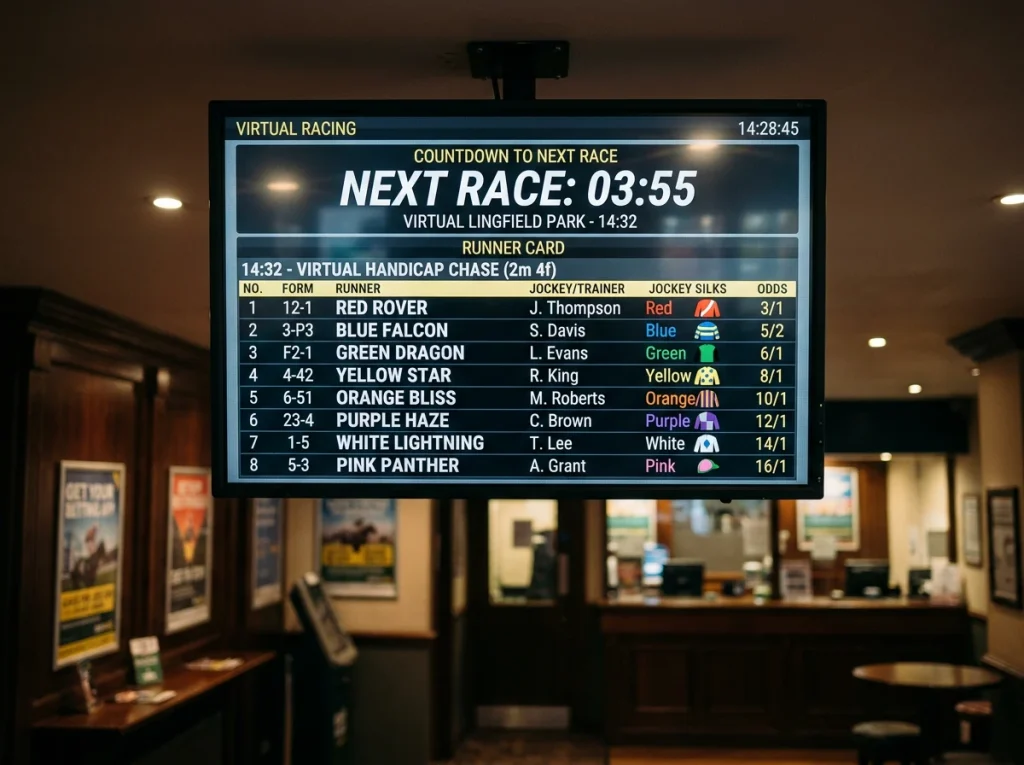
Impact of Cycle Speed on Long-Term Bankroll Exposure
If you asked me to pick one number on a virtual horse racing product that does more to shape the punter’s experience than any other, I would not pick RTP. I would pick cycle speed — the time between one round ending and the next round opening for bets. Cycle speed is the metronome that paces every other decision the punter is going to make.
The UK band sits between two and five minutes per round. At the fast end, Paddy Power runs Inspired-supplied virtual horse racing on a two-minute cycle. At the moderate end, Mohio’s pre-recorded six-runner product cycles every three minutes, eight-runner every four. At the slow end, William Hill runs a five-minute cycle on its virtual product. That spread of three minutes does not sound dramatic until you do the arithmetic on what it means across a one-hour session.
A two-minute cycle produces thirty round-loops in an hour. A five-minute cycle produces twelve. At the same stake per round, the faster product asks the punter to spend two and a half times the total handle in the same wall-clock time. Same RTP, same edge, vastly different bankroll trajectory. That is the part I want to make stick before we go anywhere else.
The 2024–2025 GSGB participation data already shows horse race betting moving in waves with seasonal racing — 7% participation in Wave 2 (April to July 2025), back to 4% in Wave 3 (July to October 2025). What that data does not break out is the virtual share inside that figure. My read, looking at retail and online traffic separately, is that the cycle speed of the virtual product is doing meaningful work in pulling betting hours into the off-peak windows. A five-minute virtual cycle behaves like a slower companion product to real racing; a two-minute cycle behaves like a primary product in its own right.
Cycle Length by Supplier and by Operator
The cleanest way to think about who runs at what speed is by supplier, because the cycle is largely a supplier decision inherited by the operator. Here is the 2026 picture I keep at the back of my notebook.
Inspired Entertainment’s Virtual Racing typically cycles every two to three minutes. The Flat product is on the faster end, Sprint compresses further on a tight loop, Jumps tends to sit closer to three minutes because the longer animation needs more time to render. UK operators carrying Inspired feeds — and there are many — generally accept the supplier’s native cadence rather than fighting for a custom rhythm.
Playtech’s virtual horse racing engine, the one powering Coral’s 90% RTP product, runs in a similar two-to-three-minute band. The engineering is broadly equivalent to Inspired’s RNG-first design, and the cycle reflects the same logic: long enough to render a credible race animation, short enough to keep the carousel moving.
Mohio Gaming’s pre-recorded product publishes its rhythm openly: three minutes for six-runner races, four minutes for eight-runner. The slightly slower cadence is structural — the engine has time built in for the cashier flow at a betting shop counter, where transactions on physical paper take longer than tapping a phone.
William Hill, whose UK virtual racing has historically sat on a five-minute cycle, is the outlier among the major bookmakers. The slower pace is a deliberate product positioning: more time between races to view form, place strategic bets and digest results. It also reflects the company’s UK-market positioning toward more considered betting behaviour, though I would caveat that even five minutes is fast compared with a real race meeting.
Below those headline players, smaller virtual products run anywhere from 90-second turbo cycles (some offshore operators push this hard) to seven-minute “studio” cycles that try to mimic a live-meeting atmosphere with paddock segments and commentary. Anything in 2026 marketed at a UK punter under two minutes per cycle is either offshore or a free-play app.
Burn-Rate Maths: What an Hour Actually Costs
Let me put numbers on what cycle speed does to a session. I will use Coral’s 90% RTP — a clean reference point — and a punter staking £2 per round on a mix of Win and each-way singles.
On a two-minute cycle, the punter completes 30 rounds in an hour. Total handle is £60. Expected loss at 10% house edge is £6 per hour. On a five-minute cycle, they complete 12 rounds in the same hour. Total handle is £24. Expected loss is £2.40. The RTP did not move; the wall-clock burn rate moved by a factor of 2.5.
Scale that to a typical three-hour session. The two-minute punter has put through £180 of handle and lost £18 in expectation. The five-minute punter has put through £72 of handle and lost £7.20. Both have played “the same product” by any marketing description. They have not had the same session.
The real worry is what happens to behaviour at the fast end. When the round-loop is two minutes long and the next betting window opens immediately, the punter rarely waits. The decision tempo accelerates. Each round is a small dopamine event, and the next one is already loading before the loss from the previous one has emotionally landed. That is the design feature regulators have been increasingly uncomfortable with — and rightly so.
The GSGB 2024 data found that 2.7% of UK adults score 8 or higher on the PGSI scale for problem gambling, with the 18–24 group at around 10%. The fast-cycle virtual product is, on a behavioural reading, one of the engines pulling that 18–24 rate above the national average. It is not the only one; high-cadence slots are also in that frame. But virtual racing’s perceived legitimacy — it looks like a sport, with form columns and silks — makes it an easy on-ramp for someone who would not sit down at a slot.
That is the underlying mechanism, and I want to be clear about it. The cycle speed does not change the maths; it changes the rate at which the maths is applied. A two-minute punter who plays for two hours is not unlucky if they lose more than a five-minute punter who plays the same two hours. They are exposed to more rounds, and rounds are how the house edge actually meets the bankroll.
What Cycle Speed Does to Responsible-Play Tools
The standard UK responsible-play toolkit — deposit limits, time-outs, reality checks, GamStop — was designed in a regulatory era when the typical online product was a real-race book with one to three meaningful bets per evening. Virtual racing breaks that assumption.
Reality checks set to ping every 30 minutes were perfectly calibrated for the bet-per-half-hour rhythm of real sports. On a two-minute virtual cycle, the same 30-minute reality check arrives after 15 rounds have already settled. That is not “checking in early”; that is checking in after a meaningful chunk of handle has already moved.
The fix on most UK virtual products is to set reality checks much tighter. I tell readers in plain terms: if you are going to play a virtual racing product on a two-minute cycle, set reality checks at 15 minutes or even 10. Set deposit limits at the daily level, not the weekly level. Set a session timer if the operator offers one. The standard defaults are calibrated for a slower product.
Time-outs land differently too. A 24-hour time-out on a virtual product is a meaningful interruption — it forces the punter to walk away from the cycle rhythm entirely and come back the next day with a cooled head. Most punters who use time-outs find them more useful on virtual racing than on real-race products, because the rhythm is what makes virtual sticky, and breaking the rhythm is the cleanest behavioural intervention.
Self-exclusion through GamStop sits across all UKGC-licensed virtual racing operators. We cover that mechanism in more depth in our piece on responsible play in a virtual horse racing game. The point I want to leave here is that GamStop works at the operator level; cycle speed determines how much harm a non-excluded punter can absorb before they self-identify the need for it.
The Regulator’s View on Cycle Speed
UKGC has not, to date, set a hard floor on virtual sports cycle length. The Remote Technical Standards cover RNG, fairness audit, settlement timing and game-pause mechanics, but they do not specify “races must not run more frequently than every X minutes”. That is partly because the regulator’s preferred lever has been on the demand side — affordability checks, deposit thresholds, financial vulnerability triggers — rather than on the supply side.
The April 2026 Remote Gaming Duty rise from 21% to 40% adds an indirect pressure. Operators carrying higher tax on each unit of GGY are less likely to push for ever-faster cycles, because faster cycles concentrate more handle in fewer punters and tend to attract regulatory attention. The market pressure is, perhaps for the first time, pointing toward slightly slower cycles rather than faster ones.
I expect the next regulatory step to be a cycle-time disclosure requirement, not a cycle-time cap. Operators may have to display “next race in X seconds” alongside an estimated rounds-per-hour figure, so the punter understands what they are buying. That would be useful. A cap would be over-engineered.
Cycle speed is the simplest knob on a virtual horse racing product, and it does more harm or more good than any other single number. Read it before you read the RTP.
Why do some operators run shorter virtual cycles than others?
Cycle length is largely set by the content supplier and inherited by the operator. Inspired and Playtech default to two to three minutes; Mohio"s pre-recorded products run three to four; William Hill"s product sits closer to five. The operator can ask for adjustments, but most accept the supplier"s native rhythm rather than fragmenting the carousel.
Can a UK operator set its own cycle speed or is it fixed by the supplier?
Mostly fixed by the supplier. The cycle is a property of the engine — its render time, settlement window and betting window — and operators usually license the product as configured. Custom cycles exist but are rare in the UK and tend to be lengthening adjustments rather than shortening ones.
Does a faster cycle mean a lower RTP?
No. RTP and cycle length are independent. A two-minute cycle product can publish 92% RTP; a five-minute cycle product can publish 88%. What faster cycles change is the rate at which the house edge meets the bankroll, not the size of the edge itself.
Articles
Prepared by the Horse Racing Bet Game editorial staff.
