
Responsible Play Features for Virtual Horse Racing Apps
 Available in US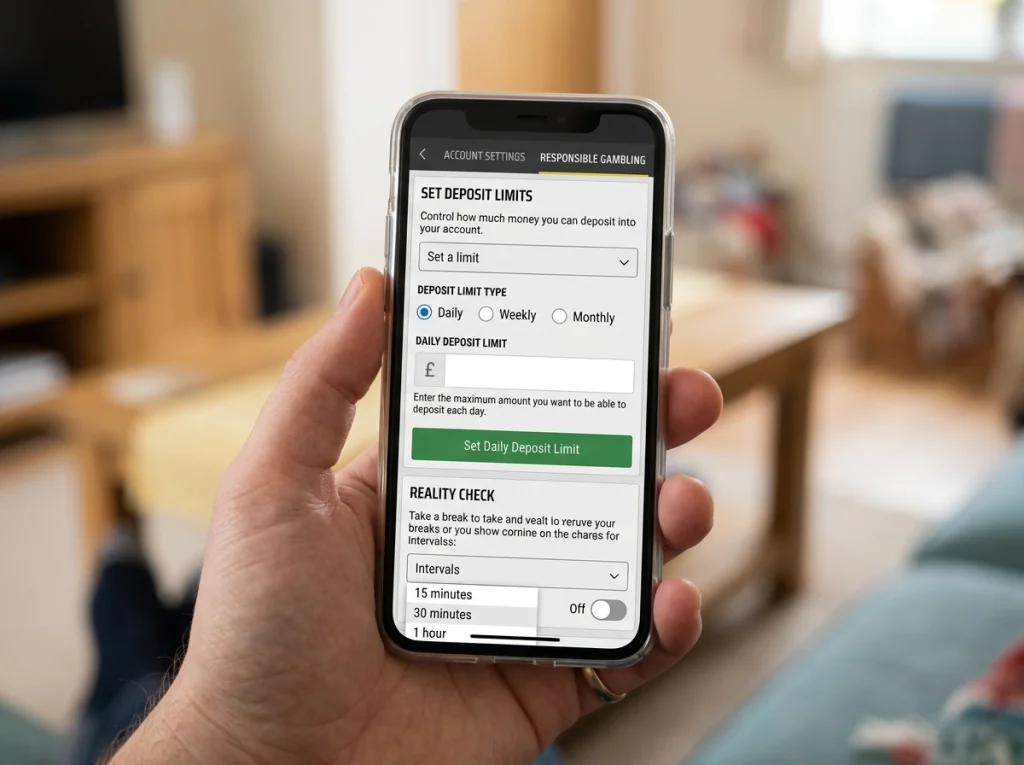
Implementing Timeouts on High-Speed Virtual Racing Loops
One of the most useful conversations I have ever had on this topic was with a friend who is a clinical psychologist. He explained that the human reward system does not process a two-minute cycle the same way it processes a fifteen-minute one. The interval between stake and outcome is short enough that the brain treats each result as an immediate feedback, which compresses learning, accelerates emotional response and shortens the gap between a loss and the next bet. That is the whole responsible-play problem on virtual horse racing in one sentence.
Real racing gives the punter natural pauses. Fifteen or twenty minutes between races at most UK meetings. Time to walk away, get a drink, watch the racing on television, think about whether to back the next one. Virtual gives no such pauses. The next race starts in two minutes whether you are ready or not. The replay of the last race overlaps with the build-up to the next one. The interface is designed to keep you inside the loop because session length is the operator’s product metric.
This is why the UK responsible-play toolkit — deposit limits, time-outs, reality checks, GamStop — needs to be configured on a virtual horse racing account from the moment it is opened, not after problems develop. The risk profile of virtual is not catastrophic. Around 2.7% of UK adults score eight or higher on the Problem Gambling Severity Index, the clinical threshold for concern. But in the 18 to 24 age band that figure rises to roughly 10%. Dr Lia Nower’s 2023 New Jersey study found 19% problem gambling in the 18 to 24 cohort — a number she has flagged as a serious public health signal. Virtual racing is not the sole cause of these figures, but the format’s structural features amplify exactly the patterns that drive them.
What follows is the practical responsible-play framework I would set up myself if I were opening a virtual horse racing account today, and the help routes that exist when self-management is no longer enough.
The Real Risk Profile of Virtual Racing Sessions
The first thing to understand about virtual horse racing risk is that the dangerous session is rarely the catastrophic one. It is the long, slow one. The customer who deposits 500 pounds and loses it all in twenty minutes will usually walk away and review their behaviour. The customer who deposits 50 pounds, plays for four hours across a Sunday afternoon, redeposits twice, and loses 280 pounds is in a more concerning pattern even though the total loss is smaller.
The reason is cycle accumulation. A four-hour virtual session at two minutes per cycle is roughly 120 decision points. Each decision involves stake selection, runner selection, market selection and confirmation. The cognitive load adds up. The customer’s attention narrows. The ability to evaluate whether the session has been positive or negative drops, because each individual cycle is small enough to feel inconsequential. By the end of the session the customer has often lost track of the running total, and the discovery that the afternoon has cost 280 pounds is itself a shock that frequently triggers further chasing behaviour.
This is the pattern Dr Timothy Fong at UCLA has been documenting in the social-casino space. In April 2026 he described to The Wall Street Journal a patient who had spent 600,000 dollars on a single social-casino app over an extended period — not in catastrophic individual sessions but in cumulative, attention-managed engagement. “He was a perfectly normal person who got sucked into the spin,” Fong told the paper. The patient never had a single bad day. He had thousands of slightly worse than expected days.
Virtual horse racing operates in the same mechanical territory. The cycles are short. The decisions are small. The feedback is immediate. The cumulative drift is invisible while it is happening and obvious only afterwards. This is why pre-session tooling matters more than post-session reflection. By the time the customer is reflecting, the session has happened.
The age dimension is the part that should sit underneath this discussion at all times. The 19% problem gambling rate Dr Nower documented in 18 to 24-year-olds is not a static fact about young brains. It reflects an interaction between developmental neuroscience — the prefrontal regulatory systems do not fully mature until the mid-twenties — and the design choices of products that pressure exactly those systems. Virtual racing’s compressed cycle is harder for a 22-year-old to manage than for a 42-year-old. The tooling does not care about age. It applies equally. But the user setting it up may underestimate how much of it they need.
Tools That Actually Help: Limits, Time-Outs, Reality Checks
The UK responsible-play toolkit on a regulated operator’s site is, in 2026, more comprehensive than most users realise. The trick is configuring it before you need it.
The deposit limit is the most consequential single tool. You set a maximum amount you can deposit per day, week or month, and the operator’s system blocks deposits above that amount until the period resets. The limit is one-directional in a useful way: reducing it takes effect immediately, increasing it requires a cooling-off period before the higher limit applies. This asymmetry exists deliberately. Set the limit conservatively when you are calm. The system protects you against the moment you are not.
The session loss limit, where the operator offers it, is more granular than the deposit limit. It caps your loss within a single session rather than your deposit across a period. This is particularly useful for virtual horse racing because it triggers based on cycle-level activity rather than on the deposit interface. A session loss limit of 50 pounds will close your active virtual horse racing session as soon as your cumulative losses across the session hit that figure, regardless of how many deposits you have made.
The reality check is the tool most underused for its mechanical simplicity. The operator sends a pop-up at a configured interval — typically every fifteen, thirty or sixty minutes — showing your time elapsed, your net win or loss for the session, and a prompt to continue or quit. On a two-minute virtual cycle, a thirty-minute reality check arrives after fifteen cycles, which is enough time to drift into the loop but short enough to interrupt before drift becomes pattern. The reality check works by forcing a conscious moment in a flow designed to suppress conscious moments. Set it at thirty minutes. The fifteen-minute version is annoying enough to be ignored. The sixty-minute version is too rare to interrupt anything.
The time-out is heavier. It locks your account from depositing or betting for a defined period — typically 24 hours, 7 days or 30 days — without requiring the deeper commitment of self-exclusion. It exists for the moment when you recognise a session is becoming a problem but you do not want to make a six-month decision. Time-outs cannot be reversed before they expire. The operator is required to honour them.
Limits and time-outs configured on one operator do not propagate to others. If you have accounts at multiple UKGC-licensed brands, each one needs its own configuration. The exception is full self-exclusion via the GamStop scheme, which I cover in the next section.
GamStop and the Virtual Racing Exit Switch
GamStop is the UK’s national self-exclusion scheme. Every UK Gambling Commission-licensed operator is required to participate, which means a single GamStop registration excludes you from every regulated UK gambling site simultaneously. For virtual horse racing this is the most decisive responsible-play tool available, because it does not depend on the operator’s individual configuration or your discipline at the deposit screen.
Registration is free and managed centrally. You provide identity details. You select an exclusion period — 6 months, 1 year or 5 years. The scheme propagates your exclusion to every licensed operator within 24 hours, and they are required to block deposits, prevent account opening and remove you from marketing communications for the duration of the exclusion. The scheme cannot be lifted early. Once you have committed to a 6-month or longer exclusion, that exclusion runs to its natural end.
For virtual horse racing specifically, GamStop closes both the obvious door and the subtle one. The obvious door is the operator’s main virtual product. The subtle one is the redeposit pathway — the operator cannot legally accept money from a GamStop-registered customer, so the chasing-loss mechanic that drives so many problematic sessions is mechanically interrupted. The customer cannot deposit again to recover losses, because the deposit will be blocked.
What GamStop does not cover is offshore. Operators not licensed by the UKGC are not part of the scheme, and a customer determined to find an offshore virtual horse racing product can do so. The IFHA traffic data showing 522% growth in UK visitors to twenty-two unlicensed sites between August 2021 and September 2024 captures part of this leakage. The BGC’s broader estimate puts roughly 6% of UK gambling activity outside the regulated framework. For a customer in genuine self-exclusion territory, accessing an offshore product is exactly the behaviour the scheme exists to disrupt. The mechanical block is one half of the protection. The decision not to seek the workaround is the other half.
Where to Get Real Help: GamCare, BeGambleAware, NHS
Self-management tools and GamStop cover most of the protective territory, but not all of it. There is a meaningful gap between “I should stop for now” and “I cannot manage this on my own”, and the resources for the second category exist regardless of whether you have reached self-exclusion territory.
GamCare runs the National Gambling Helpline, available 24 hours a day, free to call. The helpline staff are trained to handle gambling-related distress including the kind of cumulative drift that virtual racing can produce. They will not tell you what to do. They will help you work out what you want to do and how to get there. Many callers reach the helpline before they have committed to self-exclusion, and many of the calls are about figuring out whether self-exclusion is the right step. There is no minimum severity for calling.
BeGambleAware funds and signposts treatment routes including counselling, residential treatment and online cognitive-behavioural programmes specifically designed for gambling harm. The signposting works geographically — you tell them where you are, they connect you with regional services. The treatment options have grown substantially since 2020, and a customer presenting in 2026 has access to more structured pathways than was true a few years ago.
The NHS now runs gambling treatment clinics in England and parts of the rest of the UK. The route in is through your GP or directly through the NHS gambling clinic referral process. NHS treatment is free and clinical — it sits inside the same framework as treatment for any other behavioural health concern. The waiting times vary by region, but the access is real and the framework is appropriate for serious gambling harm.
If you want a complete picture of how UK self-exclusion interacts with virtual products at the operator level, the specifics of the GamStop block and what it does and does not reach are covered in detail in my piece on GamStop and virtual horse racing betting.
Frequently Asked Questions
Why are reality checks especially useful on a virtual racing app?
The two to three-minute cycle on virtual horse racing compresses the gap between decisions and suppresses the natural pauses that would let a customer notice how long they have been playing. A reality check at a thirty-minute interval forces a conscious moment after roughly fifteen cycles — enough drift to register, short enough to interrupt before the pattern locks in. Shorter intervals tend to be ignored, longer intervals arrive too late.
Does GamStop block all UKGC virtual racing operators?
Yes. Every UK Gambling Commission-licensed operator is required to participate in GamStop, so a single registration blocks you from every regulated UK gambling site for the duration of your chosen exclusion period. It does not cover offshore operators outside UKGC jurisdiction, which is the gap a determined customer can still find a way around if they choose to.
What is the most effective single tool for slowing a virtual racing session?
The deposit limit, set conservatively before you start playing. Lower limits take effect immediately while increases require a cooling-off period, so the limit protects you in moments of impulse better than any other single tool. Pair it with a thirty-minute reality check for the best combined effect on session control.
Articles
Prepared by the Horse Racing Bet Game editorial staff.
