
Virtual Horse Racing Screens in UK Retail Betting Shops
 Available in US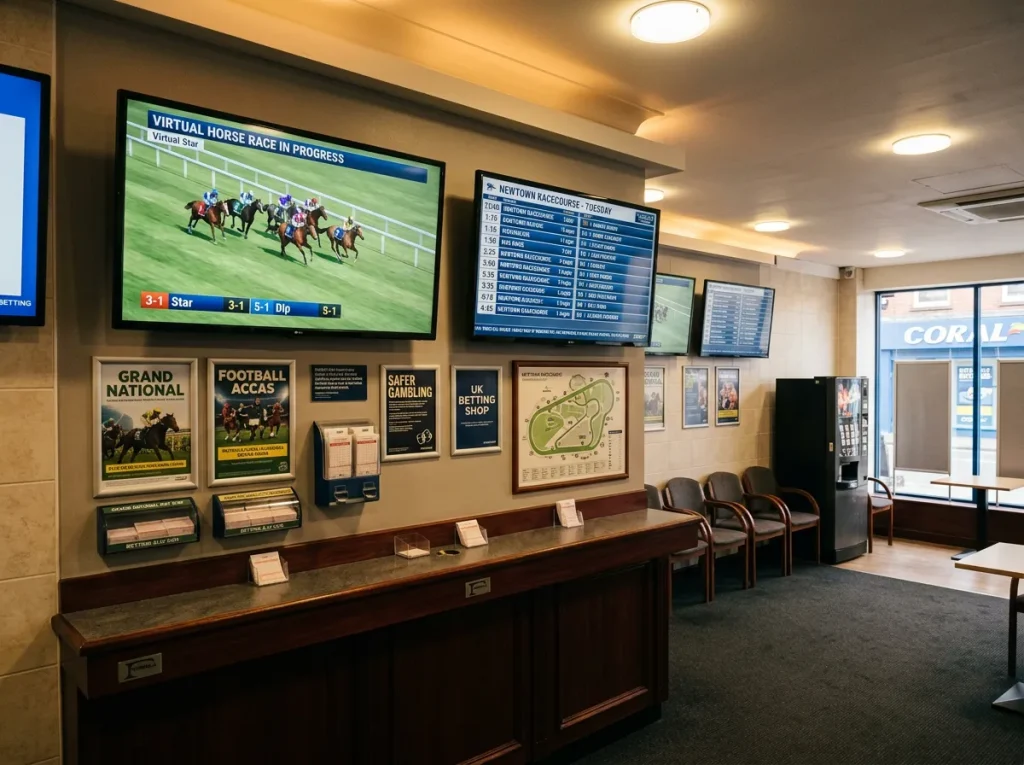
Evaluating Retail Betting Shop Virtual Racing Cadence
Walk into a UK betting shop on a Tuesday afternoon between the last race at Lingfield and the first at Wolverhampton and you will probably see virtual horse racing on at least two of the overhead screens. The bookmaker behind the counter is not bored. He is doing the same job during the virtual race that he does during the real one — taking tickets, settling slips, watching the cashier feed. Virtual is not an afterthought in the retail channel. It is a continuously running product that holds the shop together during the gaps in real-race programming.
The online conversation about virtual horse racing tends to centre on the digital experience — phone apps, web lobbies, RTP configuration. The retail experience is its own world, with its own rhythm, its own commercial logic, and its own subset of suppliers. The Mohio engine’s three-minute cycle on a six-runner card and four-minute cycle on an eight-runner card was designed deliberately for retail timing. The Inspired Racing two to three-minute cycle on its in-shop product was tuned to fit the same operational reality. These cycle lengths are not aesthetic. They are the answer to a retail question about how often the cashier can process a new ticket without queue buildup.
Through 2024 and 2025 the retail virtual racing landscape went through a quieter period than online — footfall on the UK betting shop estate softened, the broader retail gambling channel saw revenue pressure, and the August 2020 UKGC data point of UK virtual sports revenue at 6.7 million pounds with a 47.9% drop from the April 2020 peak of 12.8 million pounds is, in hindsight, the early signal of how the retail virtual cycle pulls back when the surrounding real-race programme is healthy.
This article is the retail-side complement to the online-focused pieces I have written elsewhere. It covers what the shop stack actually looks like, why the cycle rhythm matters operationally, who powers the retail product in 2026, and what the recent footfall data tells us.
The Shop Stack: Terminals, Screens and Cashier Feeds
A UK betting shop’s virtual horse racing setup involves three distinct technical layers, each of which the customer sees but rarely thinks about.
The overhead screens are the most visible. These are the displays that rotate between live real-race coverage, upcoming-meeting build-up content, the race-by-race cycle of virtual horses, virtual greyhounds, and any other virtual sports the shop has licensed. The rotation is typically scheduled by the operator’s central content management system rather than by the individual shop, and the rhythm of what appears on each screen at each moment is calibrated to the racing schedule of the day. The virtual product fills the gaps. When a major real-race meeting is running with frequent races, virtual gets less screen time. When the real schedule is quiet, virtual moves to the central position.
The self-service betting terminals — the kiosks the customer interacts with directly — are the second layer. These run the operator’s full retail betting interface and include the virtual horse racing markets alongside real-race markets, football, and other products. The terminal’s interface is designed to be readable from arm’s length under varied lighting, with larger fonts and chunkier touch targets than the equivalent online interface. The customer selects runner, market, stake, and confirms. The terminal prints a ticket.
The cashier feed is the third layer and the one most customers never see. This is the bookmaker’s interface behind the counter, which tracks every ticket sold across every product in the shop, settles winning tickets when results land, and manages the cash flow that keeps the shop’s float operating. Virtual horse racing tickets sit in the cashier feed alongside real-race tickets. The bookmaker does not need to do anything additional when a virtual race ends — the operator’s central system settles automatically and the cashier feed updates. The customer presents the winning ticket; the bookmaker scans it; the system confirms the payout amount; cash crosses the counter.
The integration between these three layers is what makes retail virtual feel seamless from the customer’s perspective. The terminal sells the ticket. The screen shows the race. The cashier pays the winner. The same three steps happen on every product in the shop. Virtual is treated as a betting product like any other, not as a special category requiring different handling.
Cycle Rhythm: Why Retail Cares About 3-Minute Loops
Cycle time on a virtual horse racing product seems like a small technical detail until you watch a shop’s busy period. On a Saturday afternoon when the real-race programme has a five-minute gap between races, every customer in the shop is processing tickets through the same window. The cashier has roughly four minutes of useful settlement time before the next real-race ticket wave arrives. If virtual is running a two-minute cycle during that window, the shop is processing virtual tickets at peak rate exactly when the cashier is least available to handle them.
The Mohio Horse Racing engine’s three-minute cycle on a six-runner card was tuned for exactly this scenario. The cycle is short enough to keep customer interest between real races but long enough to avoid overlapping with the busiest counter periods. The eight-runner four-minute cycle stretches further, which suits shops where virtual is more of an event-product than a continuous filler. Operators choosing between supplier engines for retail will frequently weigh cycle length as heavily as the product’s visual quality.
The Inspired Racing engine, with its two to three-minute cycle, is faster — closer to the rhythm of the online product. This suits shops with high traffic where the customer flow can absorb continuous activity. It also suits the operator commercially because the higher cycle rate produces higher staked turnover per day on a busy site.
The William Hill product, configured at five minutes per cycle in retail, sits at the slower end of the band. The longer cycle gives more build-up time for each race, more screen prominence per round, and a different feel — closer to a between-races event than a continuous loop. This is a stylistic choice as much as a commercial one. Different operators have arrived at different preferences for how virtual should feel inside their shop estate.
The choice of cycle length shapes how the customer experiences the product. A two-minute cycle invites continuous engagement and feels like a slot-style flow. A five-minute cycle feels like a sequence of discrete events. Neither is right or wrong — they appeal to different parts of the retail customer base. The shop’s product choice reflects which customer it is configured for.
Who Powers Retail Virtual Racing in 2026
The supplier landscape behind UK retail virtual racing in 2026 is concentrated but not monolithic. A handful of B2B vendors supply the engines, and the major retail operators choose between them based on product fit, commercial terms, and existing supplier relationships.
Inspired Entertainment is the largest supplier of virtual sports content into the UK retail channel by volume. The company’s Q4 2025 results reported an EBITDA margin of 42% with the interactive division up 53% in revenue and 60% in EBITDA year-on-year, and the Q1 2026 results showed total revenue growth of 29% year-on-year. The retail virtual racing presence is part of a broader portfolio that includes interactive games for the online channel, ad-funded games, and B2B platform services. Inspired’s content reaches shop estates across multiple UK retail operators, with the company also extending into international markets — for example, the February 2026 launch of Virtual Horse Racing and Greyhounds in Turkey through the Gametech MediaHub deal.
Playtech Virtual Sports is the engine behind the Coral retail virtual product, with the Ladbrokes brand under the same operator group using related Playtech-derived content. The Playtech retail offering is integrated into the broader operator platform and benefits from the parent operator’s scale across both retail and online channels.
SIS — Sports Information Services — is the long-standing supplier of integrated retail content, including its 49s lottery-style product alongside virtual racing. SIS distributes content through retail terminals and overhead screen feeds, and the supplier’s role is as much about data and content delivery infrastructure as about the racing product itself.
Mohio Gaming, smaller than the above suppliers, has a particular foothold in retail virtual racing because of the engine’s specific cycle-length design. Mohio’s content appears in retail estates where the operator has chosen the supplier’s cycle rhythm over the alternatives. I cover the Mohio product in more depth in my piece on Mohio horse racing virtual content, including the engine’s positioning within the broader retail mix.
Smaller independent suppliers exist on the periphery, particularly in single-shop independent estates that have not signed exclusive contracts with the major B2B vendors. These independents are not insignificant to the customers who use them, but they represent a small share of total UK retail virtual turnover.
A Quieter 2025: What Footfall Data Said
The retail betting shop estate in the UK has been under structural pressure for several years. Closures have continued, footfall has softened, and the channel mix has shifted toward online and away from retail. Virtual horse racing’s retail performance through 2025 reflected this broader trend.
The August 2020 UKGC data point — UK virtual sports revenue of 6.7 million pounds for the month, down 47.9% from the April 2020 lockdown peak of 12.8 million pounds — was the early signal of how retail virtual scales inverse to real-race availability. The April 2020 peak occurred during a period when real-race fixtures were largely suspended and virtual was the available substitute. The August 2020 drop reflected the return of real racing as the dominant product. Retail virtual revenue has continued to follow this inverse pattern, growing modestly when real-race availability tightens and easing back when the real-race programme is full.
Through 2024 and 2025 the UK real-race calendar has been broadly stable, with the consequence that retail virtual has not seen meaningful upward pressure on its share of the channel. The slower 2025 footfall affecting retail betting shops generally affected virtual along with everything else in the shop — fewer customers in the building mean fewer virtual tickets sold regardless of the product’s intrinsic attractiveness.
The 2026 picture is shaped further by the Remote Gaming Duty rise from 21% to 40% on 1 April 2026, which applies to virtual sports both online and in retail. The retail virtual margin has been compressed by the same arithmetic as the online product, and operators have responded with RTP adjustments and reduced bonusing in both channels. Retail customers experience this as slightly worse long-run returns without any visible change to the product on the screen.
Frequently Asked Questions
Are retail virtual racing odds the same as the online version?
Generally yes. The same operator running the same supplier engine across retail and online configures the product with the same RTP band and the same overround. The displayed odds on the overhead screen in a betting shop and the odds in the operator"s app for the same virtual race are mathematically equivalent. Small interface differences in how the odds are displayed are presentational rather than substantive.
Why do betting shops favour Mohio in the cashier flow?
The Mohio engine"s three-minute cycle on a six-runner card and four-minute cycle on an eight-runner card was tuned specifically for the retail counter rhythm. The cycle length is short enough to keep customer interest between real races but long enough to avoid overlapping with the busiest counter settlement periods. Operators choosing Mohio for retail are usually choosing this cycle rhythm over the faster Inspired alternative.
Has retail virtual racing turnover grown or shrunk since 2023?
The broader UK retail betting channel has been under structural pressure, with footfall softening through 2024 and 2025. Virtual turnover has followed the channel rather than diverged from it — fewer customers in the shop means fewer virtual tickets sold. The April 2026 Remote Gaming Duty rise to 40% has compressed retail virtual margins further. The category remains a meaningful filler product but is not growing share.
Articles
Prepared by the Horse Racing Bet Game editorial staff.
