
GamStop Exclusion Programs for Virtual Horse Racing
 Available in US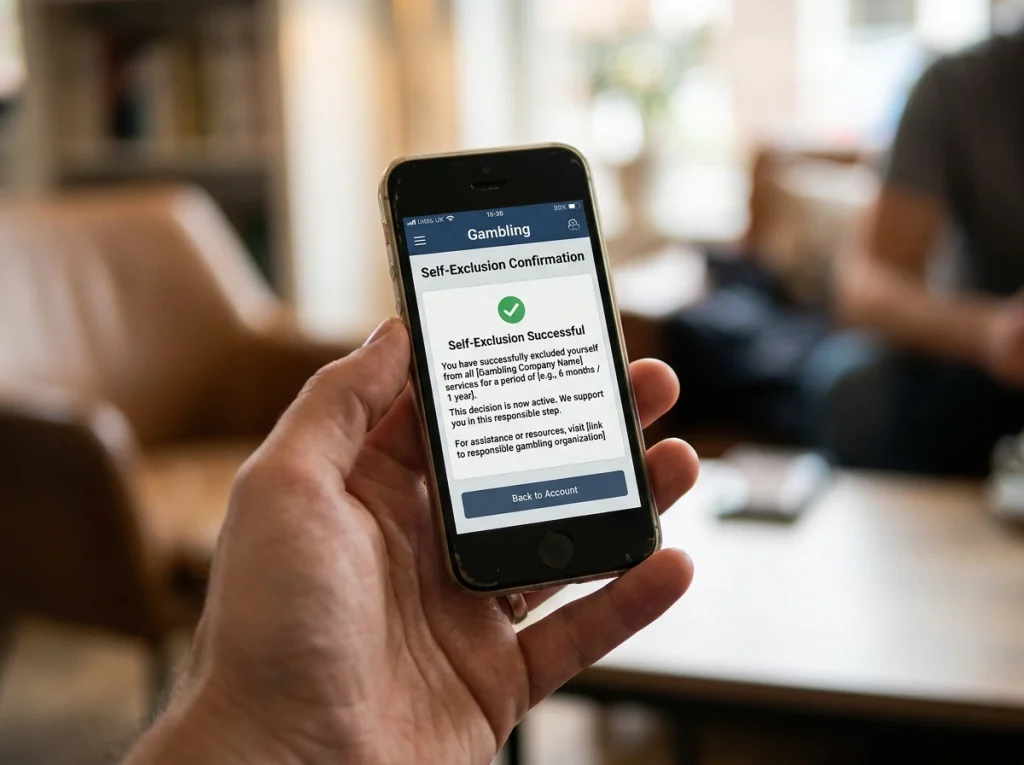
Navigating UKGC Self-Exclusion Tool Functionality
A customer wrote to me a few years back asking which UK virtual racing operators he should “GamStop himself out of” to take a break, and which he should leave open in case he changed his mind. The question revealed the misunderstanding I run into most often on this subject. GamStop is not a per-operator opt-out. It is one switch that closes every UKGC-licensed gambling site for the chosen exclusion period. There is no partial version. There is no virtual-only version. You sign up once, and every regulated product across the UK industry goes dark for you simultaneously.
This single-switch design is the most consequential safer-gambling feature in UK regulation. Every UKGC-licensed remote operator is required to participate in the scheme — that requirement is a condition of the licence itself. When a new operator brings products to the UK market, GamStop integration is one of the gates they pass through. When BetConstruct received its UKGC Combined Remote Operating Licence covering eight virtual products, GamStop integration was part of the technical compliance package alongside RNG certification.
For virtual horse racing in particular, the design matters because the format’s compressed cycle is exactly the kind of risk-amplifying structure that benefits most from a hard mechanical block. The 2.7% UK adult problem-gambling rate at PGSI 8 plus, and the roughly 10% rate among 18 to 24-year-olds, are the numbers behind the policy logic. A customer in genuine harm territory needs a switch that does not depend on their own discipline at the deposit screen.
What follows is how GamStop actually behaves once activated, what it blocks inside a virtual horse racing product, and the boundaries beyond which it does not reach.
How GamStop Behaves Across UKGC Operators
The mechanics are simpler than the public conversation sometimes suggests. You register on the GamStop website with identity details — name, date of birth, address, email, postcode and any other identifying details you commonly use across gambling accounts. You select an exclusion period of 6 months, 1 year or 5 years. The scheme then propagates your details to every UKGC-licensed operator within 24 hours.
Once propagation has completed, those operators are required to take three actions on any account they hold matching your details. They must block any further deposits. They must close any open sessions. They must remove you from marketing communications, including push notifications, email lists and any direct contact about ongoing promotions. The required actions are the same whether your account is active, dormant, or whether you have never logged in for years.
If you attempt to open a new account at a UKGC-licensed operator during your exclusion period, the operator’s identity verification stack should match your details against the GamStop registry and refuse the account opening. The match is not perfect — variations in spelling, addresses you have not declared to GamStop, or registration details that differ between operators can occasionally allow new accounts to slip through. When this happens, the operator is required to detect the discrepancy on its own checks and close the account. Customers who do find a way through are increasingly the exception rather than the norm as the matching logic has tightened.
The exclusion is not reversible during the period. This is a deliberate design choice. The whole protective function of the scheme depends on the customer not being able to talk themselves out of it on a Saturday night. A 6-month registration runs for 6 months. A 1-year registration runs for 1 year. A 5-year registration runs for 5 years. There is no operator-side appeal, no customer-side “I changed my mind” route, no negotiated reduction. The lock is real and the lock holds.
At the end of the exclusion period, the registration does not automatically convert into an account reactivation. The customer must actively choose to return. Operators are also required, under the LCCP, to apply a cooling-off process before allowing returning customers back into full activity. The friction at the back end is part of the scheme’s design.
What GamStop Blocks Inside a Virtual Racing App
Inside a UK regulated virtual horse racing product, GamStop blocks everything that involves the customer’s money or account state. The deposit interface is locked. New stakes cannot be placed. Withdrawals of existing balance remain possible — and in most cases the operator will proactively prompt the customer to withdraw any remaining balance shortly after the exclusion activates. The right to recover unstaked funds is not affected by self-exclusion.
Login itself is sometimes still permitted, though increasingly operators choose to disable login entirely for excluded customers because the alternative — allowing login but blocking betting — exposes the customer to the marketing surface of the lobby and the visible cycles of the product. Where login remains possible, the experience is stripped down to balance review and withdrawal options. The virtual racing card itself is no longer reachable.
Marketing and reactivation pressure are blocked at the same time as the betting interface. The operator cannot send you “we miss you” emails, free bet vouchers, deposit-match promotions or any of the standard reactivation campaigns that would normally land on a dormant customer. The scheme treats these communications as a workaround for the lock and bans them explicitly. If you receive marketing from a UKGC-licensed operator during your exclusion period, that is a breach of the scheme’s terms and worth reporting to GamStop directly.
What the scheme does not do is freeze the operator’s product itself. The virtual horse racing rounds continue running for every other customer. The lobby continues to display the schedule. You are removed from the product, not the other way around. This sounds obvious but the point is structurally important — GamStop is a per-customer mechanism, not a shutdown of any service.
One subtle behaviour: existing pre-placed long-term bets, where they exist, are usually settled in the normal way rather than refunded on exclusion. Virtual horse racing rarely involves long-term forward bets — the product is built on continuous cycles — but on a regulated operator’s broader account, ante-post football or futures bets typically settle on their natural outcome rather than being cancelled. The customer cannot place new bets, but the existing ticket stack runs its course.
What It Cannot Reach: Offshore and Free-Play
The reach of GamStop is defined by the UK licensing perimeter, and the perimeter has two well-known holes. The first is offshore operators not licensed by the UKGC. The second is free-play apps that do not constitute gambling under the Gambling Act.
Offshore operators serving the UK market without UKGC licensing are not part of the scheme. They are also not lawful for marketing to UK customers, but the actual access via a customer’s choice to navigate to their websites is not automatically blocked. The BGC’s 2025 estimates put roughly 6% of UK gambling activity outside the regulated framework, with around 1.5 million UK customers active on unlicensed sites and approximately 4.3 billion pounds wagered annually outside UKGC oversight. The IFHA’s traffic data on twenty-two unlicensed sites showed UK visitor growth of 522% between August 2021 and September 2024. A determined customer can find offshore virtual products. GamStop has no mechanism to block them.
This is the part of the design that gets the most criticism, and the criticism has merit. A self-exclusion scheme that closes the regulated market while leaving offshore alternatives accessible is, in effect, a scheme that depends on the customer’s ongoing decision not to seek the workaround. For customers in serious harm territory, that decision is not always reliable. The scheme is a powerful tool, but it is not a complete one.
Free-play apps are the other gap. The iHorse Betting app, the various Microsoft Store racing simulators, the social-casino crossover products that mix horse racing with slot mechanics — none of these are gambling under UK law, because no real money pays out, and the UKGC has no jurisdiction over them. GamStop has no scope to cover them. A customer self-excluded from every regulated UK product can still install a free-play horse racing simulator on their phone and rehearse exactly the cognitive loops the exclusion was meant to interrupt. This is the gap Dr David Zendle’s research at the University of York keeps pointing at, and it is the structural reason free-play products require a separate conversation from regulated ones.
A Practical Route Into and Out of Self-Exclusion
If you are considering GamStop registration, the practical route is straightforward and worth walking through ahead of time so the decision itself is not made under pressure.
Visit the GamStop website. Choose an exclusion period that feels appropriate — 6 months is the lightest commitment, 5 years is the strongest. Provide identity details that match your account information across operators as closely as you can — alternative spellings, previous addresses and old email addresses are worth including to maximise the matching scope. The registration takes about ten minutes.
Withdraw any existing balances from operators where you hold them. You do not need to do this before registering, but the cleanest sequence is to withdraw first and register second. Once registered, withdrawals remain possible, but the user experience is slower because you are interacting with an excluded account.
Tell someone you trust. The scheme does not require this, but the mechanical block is more durable when supported by a social commitment. A partner, a sibling or a close friend who knows you have registered is a useful second layer when the exclusion period feels long.
At the end of the period, take time to decide whether to return. The scheme does not push you back into the market. The default is that you remain excluded until you take a deliberate action to return. Many customers extend their exclusion at the end of the first period because the additional time has been useful. This is also covered as part of the broader UK responsible-play framework in my piece on responsible play in a virtual horse racing game.
Frequently Asked Questions
Does GamStop block iHorse Betting and other free-play apps?
No. GamStop is a UK Gambling Commission scheme that covers UKGC-licensed gambling operators. Free-play apps like iHorse Betting and the various Microsoft Store and Google Play racing simulators are not gambling under UK law because no real money pays out, so they fall outside the scheme. A customer registered with GamStop can still install and use these apps.
Can a virtual racing operator end my exclusion early?
No. The exclusion period you select — 6 months, 1 year or 5 years — runs to its natural end and cannot be lifted early by the operator, by GamStop or by your own request. This is a deliberate design choice. The protective function depends on the lock being unbreakable for the chosen duration.
What happens to a virtual racing account balance when I register with GamStop?
Your existing balance remains your money. The operator will block further deposits and prevent new stakes, but withdrawals stay available. Most major UKGC operators proactively prompt excluded customers to withdraw any remaining balance shortly after the exclusion takes effect. The funds cannot be confiscated by the scheme or by the operator.
Articles
Created by the "Horse Racing Bet Game" editorial team.
