
Virtual Horse Racing UK and US Bet Type Notations
 Available in US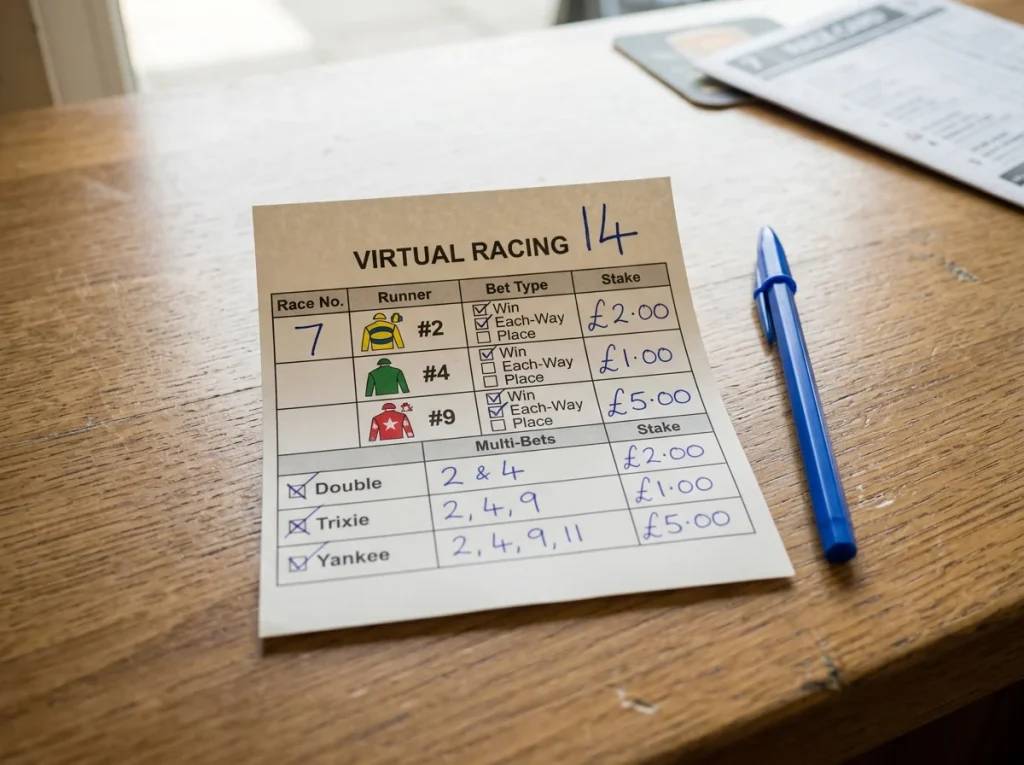
Comparing International Betting Vocabularies on Virtual Cards
The first time a friend visiting from Boston used my phone to look at a William Hill virtual race, he tapped the Forecast button and asked me why the app had renamed the Exacta. I had to explain that it had not been renamed — the UK never used that word in the first place.
This is the trap that catches a lot of casual virtual horse racing players. Open a virtual card on any UK app or terminal in 2026, and you will see UK and US bet names sitting in the same menu. Forecast next to Exacta. Tricast next to Trifecta. Each-Way next to Quinella. The reason is straightforward — virtual products are built by global suppliers like Inspired, Playtech and Mohio, and the bet menus inherit naming conventions from multiple markets. RNG-based simulations accounted for 62.8% of all virtual bets placed in 2024, with the rest split across line-in-play and event-based products, so the audience using these markets is large enough that operators standardised on a multi-vocabulary menu rather than choosing one.
The result is a quietly significant problem. Two markets that look like synonyms — Forecast and Exacta, for instance — are not always settled the same way. RTP can also vary by bet type within the same product. Inspired Racing publishes a band of 80% to 92.1% depending on which market you select, which means picking the same horses under a different bet name can change your expected return materially.
What follows is the working translation I keep in my head, with the settlement rules attached.
Singles and Each-Way: UK Default Inside a Virtual Round
Walk into any UK betting shop and the default ticket on a virtual horse race is a Win or an Each-Way single. This has not changed in the move from real to virtual. It is the bet new players reach for, and it is the one that most directly mirrors a real race.
The Win is the simplest market in the book. You pick a horse to finish first. If it does, your stake multiplies by the displayed odds. If it does not, your stake is gone. There is no second chance. On an eight-runner virtual race at a UK operator, the Inspired RTP for a Win can sit anywhere between 80% and 92.1% depending on which engine the operator licences and which odds bracket the horse falls into. Favourites tend to deliver closer to the upper end of the RTP range, longshots closer to the lower. This is not because the dice are weighted — it is because the operator margin is more aggressive in longer odds, where the percentage cushion is easier to disguise.
Each-Way is where it gets interesting. An Each-Way bet is two bets in one stake. Half the stake goes on the horse to win. The other half goes on the horse to place — meaning finish in the top two, three or four positions depending on field size and operator rules. On a virtual eight-runner race, place terms are commonly the top three at one-fifth or one-quarter of the win odds. On smaller fields of six or seven runners, place terms typically drop to the top two. On a four or five-runner field, Each-Way may not be offered at all.
The key thing to understand about Each-Way on virtual is that place terms are usually less generous than on real racing. Real-race Each-Way frequently runs at one-quarter odds on three places for handicaps with eight or more runners. Virtual rarely matches this. The default is one-fifth on three places for eight-runner fields, which compresses the place-side payout and shifts the bet’s expected value downward. The operator is not being unkind — it is reflecting the fact that virtual fields are statistically tighter than real ones, with a narrower spread of outcomes, so place returns need a steeper reduction to keep the book balanced.
If you are coming from the US to the UK menu, the closest equivalent to Each-Way is the Win and Place combination as a single ticket — but it is not identical, because US Place bets are settled independently rather than at a fixed fractional odds reduction. I cover that mechanic in detail in my piece on each-way bets on virtual horse racing, including how virtual operators set their place fractions.
Forecast and Tricast: The UK Side of Exotics
If Win and Each-Way are the entry-level markets, Forecast and Tricast are where the UK exotics start. They are the bets that, in my experience, separate the casual virtual punter from the one paying real attention to the card.
A Straight Forecast asks you to pick the first two horses in the exact order they finish. First place horse and second place horse, in that sequence, no swap. If you have the order wrong but the horses right, the bet loses. The payout is calculated using a tote-style formula on virtual products — the operator publishes a forecast dividend after the race, derived from the implied probabilities of the two horses involved. A Straight Forecast on a longshot pair can return triple-digit multiples of stake. The expected value is brutal, however, because the operator margin on exotic markets is wider than on Win or Each-Way.
A Reverse Forecast covers both possible orders. Stake one pound on a Reverse Forecast and you stake two pounds in total — fifty pence on each combination. If either order comes home you win. The protection costs you the doubled outlay.
The Tricast extends the same logic to three horses. You pick the first, second and third in correct order. On a typical UK virtual eight-runner field, the Tricast dividends published by the operator can climb into the hundreds-to-one and occasionally the thousands-to-one for outsider combinations. They look like jackpot tickets and feel like jackpot tickets. They are not. They are extremely high variance bets where the RTP, factored across many attempts, sits at the floor of the Inspired range rather than the ceiling.
What is worth knowing for anyone betting virtuals in 2026 is that Forecast and Tricast dividends on virtual are calculated from implied probabilities rather than from a real pari-mutuel pool. There is no pool. The operator constructs a synthetic dividend based on the displayed odds at the moment the bet is placed. This means the dividend you would receive on a winning Forecast can be different from the dividend a friend received for the same combination two races ago, even if the horses had the same starting odds — because the system rounds and packages the calculation slightly differently each cycle. It is fair, in the sense that it is auditable and certified, but it is not pool-driven.
Exacta, Quinella and Trifecta: US Side of the Same Bet
Cross over to the US-named exotics on the same UK virtual card and the menu looks unfamiliar but the underlying logic is close.
The Exacta is the US sibling of the Straight Forecast. Pick the first two in exact order. Same constraint. The difference is in settlement convention rather than mechanics. In US racing, an Exacta is settled from the pari-mutuel pool. On a UK virtual the Exacta is settled from the same synthetic dividend the Forecast uses. The dividend will, on a fair virtual product, be identical to the Forecast dividend for the same combination — because mathematically they are the same bet. Where the dividends differ on a virtual product, you have a flag to investigate. Either the operator is rounding aggressively in one direction, or the markets are being treated as separate liquidity buckets. Neither is reassuring.
The Quinella is where the convention diverges. A Quinella on a US card asks you to pick the first two horses in any order — one combination, one stake, either ordering wins. This sounds identical to a Reverse Forecast, but it is not. A Reverse Forecast is two bets at half-stake each. A Quinella is one bet covering both orders, settled from a different price calculation. The dividend on a Quinella is typically lower than on a Reverse Forecast for the same outcome, because the Reverse Forecast pays the full Straight Forecast dividend on the half that hits, whereas the Quinella pays a single blended dividend across both orders. On a longshot pair, the Reverse Forecast usually outperforms the Quinella. On favourites, the gap closes.
The Trifecta is the US sibling of the Tricast — first, second and third in exact order. Same logic, same dividend construction on a virtual product, same RTP positioning at the floor of the operator’s published range. If a UK virtual offers both Tricast and Trifecta side by side, which some do, they should pay the same dividend for the same outcome. If they do not, the difference is operator margin spread across the two menu names rather than a genuinely different bet.
One subtle point that catches US visitors: the Quinella is rarely deeply liquid on UK virtual products because the UK audience does not ask for it. Operators include it for completeness and to give the US-named market a home, but they often price it conservatively. I would not build a strategy around it on virtual.
Box and Reverse: Permutations Made Cheap
Box and Reverse are not separate bets. They are stake-handling instructions layered on top of the exotics above. They are also the markets where novice players burn through bankroll fastest, and they deserve a clear explanation.
A Boxed Trifecta or Boxed Tricast covers every possible ordering of the horses you pick. Box three horses and you have six combinations. Box four and you have twenty-four. Box five and you have sixty. A pound boxed across five horses in a Trifecta is a sixty pound outlay, even though the slip looks small.
A Reverse Forecast, as covered above, is the two-horse version of the same logic. Box and Reverse exist because the alternative — manually filling in every permutation as a separate ticket — would be exhausting on a two-minute cycle. The operator’s interface bundles the permutations into one ticket.
The reason these structures matter for virtual specifically is the cycle speed. On real racing you have ten or fifteen minutes between races, time to actually think about how many horses to box. On a virtual race running every two or three minutes you have neither time nor cooling-off period. The box function makes it easy to upsize a stake without registering the upsize. Punters who would never put forty pounds on a single horse will happily box four horses in a Trifecta and not notice that they have just committed twenty-four pounds to one race.
If you take one habit away from this article, take this one: when you tap the Box option, look at the total stake field at the bottom of the slip before you confirm. The operator shows it. Few players read it.
How the Menu Maps Onto Itself
To pull this together, here is the working translation I keep in my head. UK Win equals US Win. UK Each-Way is roughly US Win-and-Place combined, with different settlement. UK Straight Forecast equals US Exacta. UK Reverse Forecast is similar to but not identical to US Quinella. UK Tricast equals US Trifecta. Box and Reverse apply identically across vocabularies.
Where the maths gets sharp is the RTP variation. The Inspired range of 80% to 92.1% across bet types is not flat. Win sits at the top of the band. Exotics sit closer to the floor. Each-Way is in the middle. Operator margin is widest where the dividends look most attractive, which is exactly the trade-off the structure obscures. Knowing the mapping is useful. Knowing where the margin lives is what actually protects bankroll.
Frequently Asked Questions
Is an Exacta the same as a Forecast on a virtual race?
Mathematically yes — both ask for the first two finishers in exact order, and both settle from the same synthetic dividend on a UK virtual product. If a single operator offers both Exacta and Forecast side by side, they should pay identical returns for the same outcome. If they do not, that gap is operator margin distributed across the two menu names rather than a different bet.
What is the difference between Quinella and Reverse Forecast?
A Reverse Forecast is two separate bets at half stake each, covering both orderings. A Quinella is one bet covering both orderings, paid out at a single blended dividend. On longshot pairs the Reverse Forecast typically returns more than the Quinella for the same outcome, because the half that wins pays at the full Straight Forecast dividend. On favourites the gap closes.
Does each-way pay the same on virtual as on real?
No, and this is one of the most common misunderstandings. Real-race each-way often runs at one-quarter odds on three places for eight-plus runner handicaps. Virtual typically pays one-fifth on three places for the same field size, sometimes only two places. The compressed place terms reflect the tighter outcome distribution of an RNG product.
Articles
Prepared by the Horse Racing Bet Game editorial staff.
