
Evolution and History of the Horse Racing Betting Game
 Available in US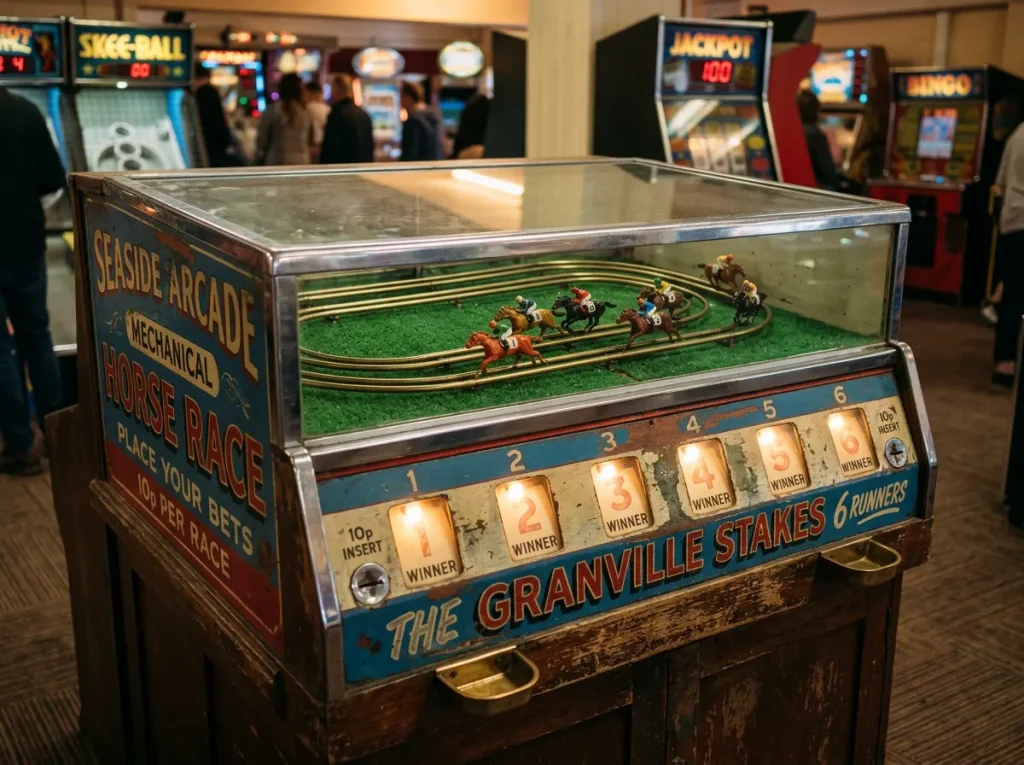
Origins of the Modern UK Virtual Racing Platform
The first time I traced the genealogy of a modern UK virtual horse racing product back through its design lineage, I expected to find a single starting point — a defining piece of software in the early 2000s, perhaps, when the UKGC framework was settling into its current shape. What I found instead was three separate lines of inheritance, each visible in today’s product. The mechanical horse race machines of mid-twentieth-century British seaside arcades. The arcade cabinets of the 1980s. And the software virtual sports products that grew up under UK licensing through the 2000s. Each line contributed something — visual conventions, UX habits, commercial expectations — that survives in the 2026 product.
The scale of the modern market is itself a footnote to this longer history. Global virtual sports betting was valued at 14.88 billion US dollars in 2025 with projected growth to 47.43 billion by 2032 at a compound annual growth rate of 18%. A separate Market.us analysis tracked the category at 14.4 billion in 2024, 17.7 billion in 2025, 21.6 billion in 2026, and projected 110.5 billion by 2034. The growth rates are the obvious story, but they only make sense once you understand what the product is descended from.
One industry editorial summary, looking back at the formal emergence of virtual racing in the early 2000s, captured the moment well: it framed the category as a new form rather than a translation of real racing, and the framing has held up because the form did genuinely differ from what came before. The horse races on screen looked like horse races, but the mechanics underneath were a fully RNG-driven fixed-odds product unlike anything previously delivered to retail customers in the UK.
What follows is the working timeline I use when I need to explain to people new to this space how the modern product arrived at its current shape.
As technology rapidly evolved from mechanical arcade machines, the industry split into two distinct formats: pre-recorded vs RNG virtual horse racing.
Mechanical Tracks and 1980s Arcade Cabinets
Before any electronic horse racing game existed in the UK, there were mechanical horse race machines on seaside piers and in amusement arcades. The Penny Falls genealogy is the wrong place to start — those were coin-pusher machines. The relevant ancestor was the upright horse race cabinet with miniature horses on track, set in motion by a mechanism that resembled an early electromechanical fruit machine. Customers would choose a horse from a printed selection panel, drop coins into the corresponding slots, and watch the mechanical horses race along their tracks. The winning horse paid out a small prize, often a stamped token or, in some venues, low-value cash.
These machines existed in UK seaside resorts from the 1950s through to the late 1970s. They were not formally regulated as gambling — they sat under the general amusements framework — and the prizes were modest enough that the legal classification was rarely tested. What they did culturally was establish the basic format of a horse racing game as a multi-runner event with selection, stake and outcome compressed into a single short cycle. The customer’s role was to pick a horse, commit a small sum, and see the result within seconds. This template survived into every later electronic version.
The arcade cabinets of the 1980s expanded the format with electronics. Cabinets like Konami’s Photo Finish and other multi-player horse racing machines brought computer-generated horses, electronic scoring, and the first hint of multi-station betting interfaces. The cabinet might host four or six customers around a central screen, each at their own selection terminal, each placing notional bets on the same generated race. The cabinets paid in tokens that could be exchanged for prizes within the arcade rather than for cash, keeping them outside formal gambling regulation in most jurisdictions, including the UK.
What the arcade cabinets contributed to the modern product was the visual grammar. The overhead three-quarter view of horses rounding a bend, the synthetic commentary, the bright on-screen odds display — these conventions appeared in 1980s arcade halls and survived into the 2000s software virtual products with surprisingly little modification. A 2026 customer playing an Inspired Racing virtual round is, in visual terms, playing a more refined version of a Konami cabinet from forty years earlier.
The Move to Software: 1990s and 2000s
The 1990s saw the transition of horse racing simulation from dedicated arcade hardware to general-purpose computer software. The earliest software horse racing games of this era were entertainment products rather than betting products. Stable Master, the various PC horse racing management games, and a long catalogue of independent simulators ran on home computers, console platforms and early online services. None of these were gambling products in the regulated sense — they were stable-management and racing-strategy games where the player controlled trainer decisions, bred horses, and ran them against AI competition.
The shift toward betting-style software came alongside the broader move of UK gambling to the remote channel. The Gambling Act 2005, which came into force in 2007, established the framework under which RNG-based products could be offered to UK customers under remote operating licences. Before this framework was fully in place, the regulatory home for virtual horse racing products was uncertain — and several early entrants operated under earlier permissions that were tested by the new framework when it arrived.
The first generation of modern virtual horse racing — the products that look recognisably like the 2026 offering — appeared in the second half of the 2000s. Inspired Entertainment’s predecessor entities had been working in the virtual sports space since the early 2000s, and the Inspired Racing engine that powers UK retail virtual racing today is the direct descendant of those early products. Playtech entered the virtual sports market in a similar timeframe and built the engine that now powers the Coral retail and online virtual horse racing offering at a flat 90% RTP across its products.
What characterised the software-era products from the start was the use of certified RNGs. The arcade cabinets of the 1980s had used pseudorandom generators with limited statistical certification because the regulatory context did not require it. The software-era virtual products were built from the start to be tested and certified, because UKGC remote licensing required exactly that certification before any product could launch. The Inspired Racing RTP band of 80% to 92.1% across bet types reflects this period’s regulatory expectations baked into the engine’s calibration.
By the late 2000s the basic architecture of the modern product was set. RNG generates horse probabilities. Engine applies overround to produce displayed odds. Race animation plays out the simulated result. Customer-facing interface accepts bets, settles tickets, and starts the next round. The cycle has not changed at the architectural level since then. What has changed is the visual fidelity, the breadth of bet types, the integration with broader operator platforms, and the regulatory weight of the customer-protection framework around the engine.
The Birth of Modern Virtual Sports
The Past The Wire editorial summary of virtual racing’s emergence positioned it as a new form rather than a substitute for real racing, and the framing is worth revisiting because the distinction has shaped how the category has been treated commercially and regulatorily ever since.
Virtual horse racing in its modern form is not a translation of real racing into software. It is a different product that shares the visual presentation. Real racing involves real horses with real form, real jockeys with real preferences, real trainers with real strategies, and a real race that unfolds based on actual physical events. Virtual racing involves software-generated probabilities, synthetic odds, animated horses with no underlying form, and outcomes that the operator’s RNG produces from the configured distribution. The customer pays a stake. The maths underneath determines the result. The horses are decorative.
This distinction matters because it explains why virtual is taxed as a gaming product rather than a betting product. The 1 April 2026 Remote Gaming Duty rise from 21% to 40% applies because virtual horse racing is, in HM Treasury’s classification, casino-equivalent rather than racing-equivalent. The animal on the screen is a horse, but the product behaviour is a slot game. The tax framework follows the product behaviour, not the imagery.
The distinction also explains why the customer-protection framework treats virtual the same as casino. Affordability checks at 150 pounds monthly net deposits apply because the product’s cycle and engagement pattern resemble casino products. GamStop coverage applies because the product is regulated gambling under the UKGC. Self-exclusion works on virtual the same way it works on slots. These protections are calibrated to the product’s behavioural profile, which is more casino than real-race.
The Past The Wire framing — virtual as a new form — was prescient because it identified that the category would settle into its own regulatory and commercial niche rather than being absorbed into either real-race betting or general casino. That settling has now happened. Virtual horse racing in 2026 is a distinct product category with its own supplier ecosystem, its own customer base, and its own regulatory profile.
Discover the full evolution of digital track betting and modern software on our authoritative virtual racing platform.
The 2026 Shape: Big Suppliers, Many Skins
The 2026 market for UK virtual horse racing is concentrated at the supplier level and fragmented at the operator level. Three or four major B2B suppliers — Inspired Entertainment, Playtech Virtual Sports, Mohio Gaming and SIS — power the majority of UK virtual content. Each major UK regulated operator picks one or more of these suppliers and presents the content under the operator’s own branding.
The result is that a customer betting on virtual horse racing at three different UK operators may, behind the brand veneer, be betting on the same underlying engine three times. The horse names differ, the colour palettes differ, the interface chrome differs, but the RNG, the probability model, and the certified RTP band are common to the supplier’s engine. This is the “many skins” reality of the modern market. The product variation is largely cosmetic. The mathematical core is shared.
This concentration is a stable feature of the category and continues to shape commercial dynamics. New suppliers entering the UK market face the licensing path BetConstruct walked when receiving its UKGC Combined Remote Operating Licence covering eight virtual products — a substantive regulatory effort to reach what is, structurally, a mature market with established suppliers already filling the operator demand. The historical trajectory I have just traced reaches the present where the category is consolidated, certified, and commercially balanced. How it spiked above its normal volumes during the 2020 lockdown period is a related story I cover in my piece on why virtual racing spiked during COVID.
Frequently Asked Questions
When did virtual horse racing first appear under a UK licence?
The first generation of modern virtual horse racing under formal UK remote-licensing emerged in the second half of the 2000s, following the Gambling Act 2005 coming into force in 2007. Earlier electronic horse racing products existed in arcades and on PC, but those operated outside the gambling licensing framework. The Inspired and Playtech engines that dominate today"s market trace their origins to this late-2000s period.
Which arcade titles shaped the modern UI of virtual racing?
The 1980s arcade cabinets, including Konami"s Photo Finish and similar multi-player horse racing machines, established the visual grammar that survives in today"s products — the overhead three-quarter view of horses rounding a bend, synthetic commentary, bright on-screen odds displays. The 2026 software virtual is, in visual terms, a refined descendant of these cabinets.
Was there a horse racing game before electronic betting shops?
Yes. Mechanical horse race machines existed in UK seaside arcades from the 1950s onward, with miniature horses on tracks set in motion by electromechanical mechanisms. These predated electronic gambling regulation in the UK and operated under the general amusements framework rather than as licensed gambling products. They established the format of a multi-runner short-cycle horse race game that survived into every later electronic version.
Articles
Created by the "Horse Racing Bet Game" editorial team.
